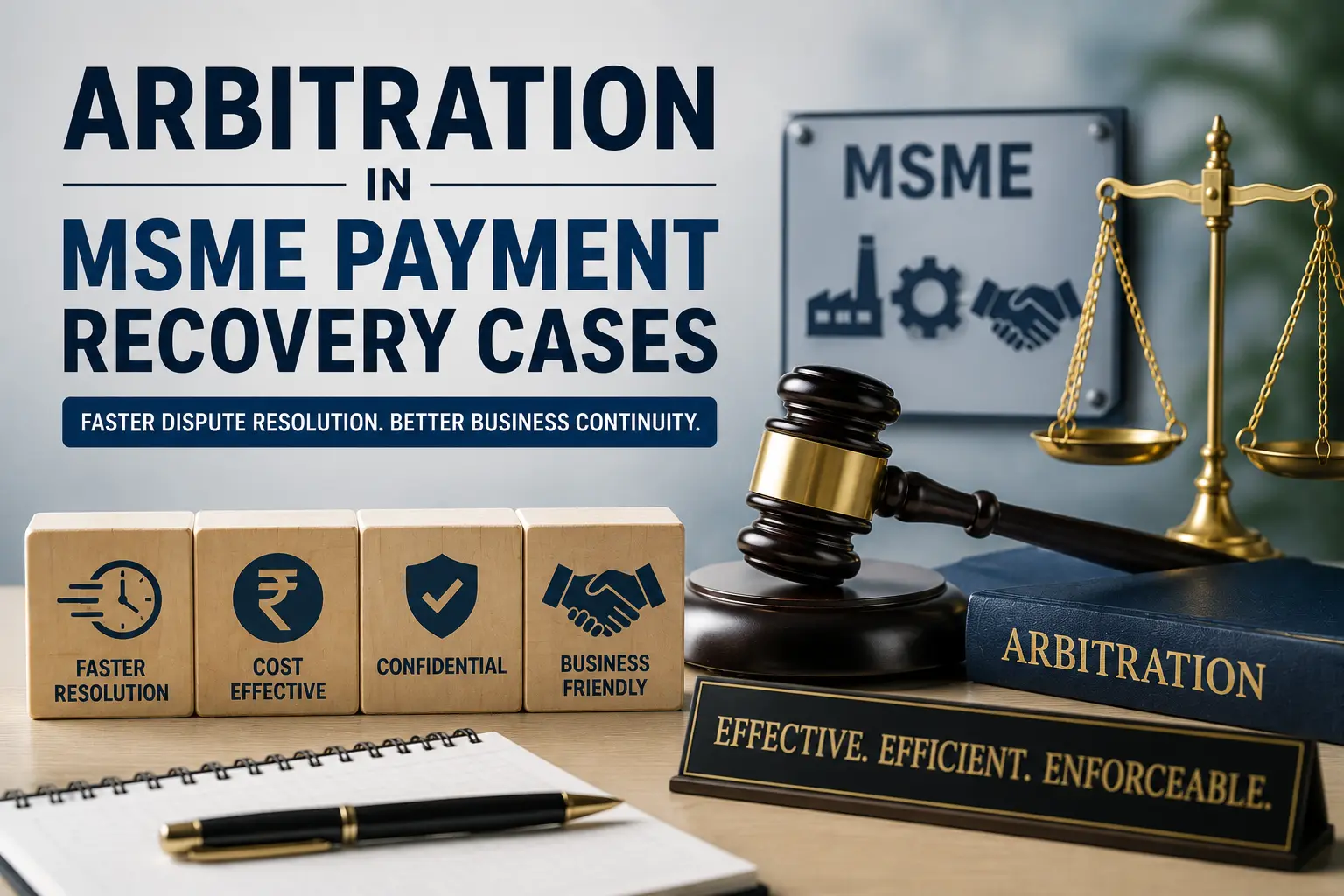
Delays in payment can break a small business faster than delayed orders. Many MSME owners in India get a big invoice wrong from a high-value buyer. They struggle to pay salaries to their staff. GST notices pile up. Calls come from worried vendors. Bank EMIs become stressful. Sleep stops for harassed owners. A manufacturer in Ghaziabad sends parts to a bigger entity and waits months to get paid. A service provider in Noida completes IT work and hears nothing but promises. A packaging supplier in Faridabad phones politely and then gets his buyer to stop taking calls. Arbitration for MSME Payment Recovery. Under Indian law, micro and small suppliers get special statutory recourse for delayed payments. The first step is the Micro and Small Enterprises Facilitation Council, often referred to as MSEFC. MSEFC may conduct conciliation. If settlement is not possible, arbitration is the next step. Arbitration may be held before the Council or before an institution or center offering dispute resolution services. The MSME mechanism is not a normal civil recovery suit. Neither is it just like commercial arbitration which could arise from an arbitration clause in a contract. MSME-related arbitration has its own statute, interest implications, forums, documentation and challenging process. Lawyer BK Singh counsels MSME owners, suppliers, startups and service providers every day on whether they need to send a legal notice, file before MSME Samadhaan, start MSEFC proceedings or begin arbitration under a contract. Each situation is different. Answers depend on when the invoice was raised, Udyam registration status, buyer category, record of communication, jurisdiction and limitation. This easy-to-read article walks businesses through each step in Delhi NCR, Delhi, New Delhi, Ghaziabad, Noida, Greater Noida, Gurugram, Faridabad, Meerut, Hapur, Lucknow, Kanpur, Prayagraj, Varanasi, Agra, Jaipur, Chandigarh, Mumbai, Pune, Bengaluru, Hyderabad, Chennai, Kolkata, Ahmedabad and other Indian cities with commercial activity. Payment disputes for MSME suppliers have worsened over time. Credit terms expanded for businesses. Ordering patterns went digital and informal. Many buyers simply don’t pay despite accepting delivery or services. For small suppliers, late payments are an existential problem. They don’t just lose rupees. They lose ability to pay staff on time, comply with tax laws, raise working capital and bid for new business. Delhi NCR vendors supply to big companies, real estate developers, manufacturers, hospitals, schools, e-commerce dealers, contractors and service aggregators. Many issues raised after payment demands are generic quality objections. But these are voiced only after the buyer stops responding to phone calls. The buyer may have complete invoices, proof of delivery and emails accepting performance. Yet after some weeks, he suddenly ‘finds’ quality issues only after a legal notice talks about filing cases. Arbitration for MSME Payment Recovery matters because it allows eligible micro and small suppliers to access a statutory dispute resolution process. The MSEFC process can be initiated without filing a civil suit. If conciliation before the Council does not yield results, arbitration follows. Advocate BK Singh has noticed that business owners delay sending a notice for too long because they do not want to disturb a commercial relationship. They hope the buyer will pay someday. In my experience, that rarely works. Evidence gets diluted. Limitation weakens. Settlement leverage is lost. Recovery threat diminishes. Delay affects both MSME buyers and sellers in active business hubs like Delhi NCR. Many small businesses start arbitration while also sending settlement offers. Not every matter requires aggressive litigation. Some clear cases settle after a well-drafted legal notice. Some situations need MSEFC filing. Others require immediate arbitration. Pick a path, but do so based on facts. MSME payment recovery refers to arbitration arising out of a statutory claim by eligible micro or small suppliers for non-payment of dues. The dispute is referred to MSEFC and when conciliation under MSEFC does not resolve the conflict. In simple terms: did the buyer receive supply from the seller and fail to pay due amount within the stipulated time? However, raised objections are usually not that simple. A buyer may say quality was not good. Or they may claim delivery was late. Many buyers say the invoice was not approved. Some say suppliers were never MSME registered under Udyam. Certain buyers may file set-off claims, produce debit notes or say that discounts were agreed upon orally / informally. That is why MSME cases are document-intensive. The supplier needs to prove the purchase order/work order, invoices, delivery challans, proof of service, emails/whatsapp correspondences, ledger notes, payment reminder emails/whatsapp and evidence of acceptance of order. If it was an oral deal, the supplier may have to rely on supportive documents and possibly affidavit-based explanation to the Council in some cases. Lawyer BK Singh generally tells clients that MSME filing is not a simple fill-in-online-forms job. Just because the online form is easy, it does not mean that legal requirements are relaxed. Filing a weak claim hastily just gives the other side grounds to object. Every invoice must state facts clearly and link to evidence. Arbitration for MSME matters under MSEFC is also different from private arbitration under a contract clause in a sale agreement or supply deed. Private arbitration revolves around an arbitration agreement. MSME arbitration under the MSMED Act is a statutory remedy for specified delayed payment disputes. Forums, jurisdiction and challenges are different. The primary law is the Micro, Small and Medium Enterprises Development Act, 2006. Chapter V of MSMED Act covers delayed payments to micro and small enterprises. Read that chapter carefully. You will also encounter the Arbitration and Conciliation Act, 1996 along the way. Conciliation applies at the MSEFC settlement stage. Arbitration? comes into play after referral. Award enforcement, challenges, right to a fair hearing and procedural requirements get analyzed under the Arbitration Act. Be cautious of shortcuts. Only because you have old unpaid invoices does not mean that your claim is certain. Look at limitation, Udyam registration date, evidence you have, jurisdiction issues and buyer’s objections. The buyer may also already have filed a civil suit for the same amount. This has procedural consequences. If the buyer is a foreign company, can you use MSME law in India against them? Different rules may apply. Visit MSME Lawyers India for services and information on MSME legal support for payment recovery, business disputes and MSME lawyer representation. Micro and small enterprises who extend credit to others for their goods or services. This includes manufacturers, fabricators, consulting firms, packaging units, IT providers, logistics companies, marketing agencies, contractors, vendors for repairs, designers, manpower suppliers, printing press owners, suppliers of component parts, legal firms and more consultancies. Delhi NCR has many such vendors. The buyer accepts the goods or services. Uses them. Says nothing in the beginning. Then after a few weeks or months, ignores phone calls. Accounts departments promise “next cycle” clearance. Top management suddenly does not reply. Customers approach lawyers when some invoices are already out of limitation. Buyers need to read this too. If you are a buyer who receives a MSEFC notice, do not ignore it. Reply politely but do not give away your position. Gather all your documents such as proof of timely rejection, debit notes, contract terms and correspondence carefully. File your reply to MSEFC with all evidence in order. Startup companies can benefit too. Founders tend to sign work orders without agreeing to payment terms, delivery acceptance, invoice approval conditions or dispute escalation process. They later regret it when they realize chasing invoices requires paperwork from day one. Lawyer BK Singh recommends both claimants and defending buyers to take MSME disputes seriously. Keep communication polite but firm. Preserve your evidence. Need help with MSME payment dues in Delhi? Check out MSME Payment Recovery Lawyer in Delhi for more detail on local lawyers who understand recoveries in Delhi. Every MSME delayed payment claim begins long before a notice is filed. The supplier should look at the invoices they have not received payments for, related work order, proof of delivery, ledger and payment reminders sent to the buyer. Serious legal evaluation starts by checking if the supplier had active Udyam registration when the supply happened, whether the buyer was a domestic buyer within the meaning of MSMED law, whether goods or services supplied fall within the ambit of the MSMED claim and whether the invoices are out of limitation. Preparing a legal notice or formal demand for payment is the next step many suppliers take. Legal notice is not mandatory at any stage under MSEFC filing but serves two purposes. It documents your demand and gives the buyer a chance to settle before you initiate a legal process. Many commercial claims settle at the legal notice stage if it is sent accurately, refers to invoices specifically and is supported by documents. If no payment is received, or if a false promise is given, the supplier can send a delayed payment application through MSME Samadhaan window or before the concerned MSEFC following applicable rules. Vague references to multiple invoices against a buyer won’t work. List down invoice numbers, dates, amounts mentioned in purchase order, delivery proof and payment reminders methodically. Once filed, the MSME matter reaches the concerned Facilitation Council. The Council reviews the application and issues notice to the buyer for his side of the story. Often both parties are called or asked to submit documents. Usually, MSEFC tries conciliation first. It wants the parties to settle. If the buyer admits that he needs to pay, parties can discuss payment terms. Otherwise, the Council notes the buyer’s statement on dispute. If conciliation fails, MSEFC refer the matter for arbitration. Arbitration entails a more judicial process. Claimant has to prove his claim. Buyer has to file a structured reply. Council or the institution may call for evidence, pleadings, written submissions and hearing. An award is given based on the disputes submitted. Upon award, if the buyer pays up, that’s great! Congratulations your problem is solved. If the buyer decides to challenge the award, time limit and requirement for challenging the award need to be examined under the arbitration law. If the award is not challenged or is set aside by the court, the awarded amount can be enforced as money due under the arbitration law. Lawyer BK Singh believes in helping clients put their claim together in a way that helps the Council or arbitrator understand the matter quickly. Files should tell the story of order, supply, acceptance, invoice sent, payment demands made and amount currently due. For cases already filed in MSEFC arbitration or conciliation process, see MSEFC Arbitration and Conciliation Cases Lawyer. MSME Claims are about documents. Oral assurances can provide background but not enough to obtain an award. Whenever possible, gather all documents before filing your MSEFC or arbitration claim. Documents. Do NOT dump unreadable PDF documents in a folder. Add context. Councils and Arbitrators are humans. Send invoice-wise indexes. Arrange facts in a chronological order. If there is a rejection of goods by buyer, ensure it is a genuine rejection and is communicated to you on time. Don’t let buyers protest quality only after payment reminders start arriving in their inbox. For service-based disputes, show email of service completed, login records, reports shared, screenshots of work performed, acceptance certificates if applicable and proof of use. Lawyer BK Singh usually asks clients to submit a short case-note along with their filings. Case note includes name of parties, Udyam registration number/status of both parties, nature of supply (goods/services), table of invoices, payment history, date of default, detail of correspondence and relief sought. Acting against late payments is important. A supplier should not let invoices get older because with time, limitation weakens claims and evidence gets diluted. Business owners think since the buyer has paid them before, he will eventually pay this time too. They call once a month, then after two months, then after another few months. By the time they act, buyers have hired new staff, deleted email trails or come up with excuses on how they settled with you verbally. MSEFC has a mandated timeframe within which it should resolve references. Real-life delays happen because of notice serving, buyer asking for time, documentation deficiencies, heavy council case-load or referrals to outside institutions. Businesses should factor this in their plans. For sellers, first decision window is when the payment becomes overdue. Send them a reminder. In writing. Second window is when they stop committing to a date for payment. That is the stage to send a legal notice. Third decision window is when buyers start saying the invoice was never approved or the supply was defective. You may have to send legal papers if the buyer simply does not agree to pay what is due. Buyers too have windows for decisions. Once you receive an MSEFC notice, respond on time. If you truly have a quality defect issue, show the Court timely notice of rejection. If you want a settlement, propose a realistic payment and get it recorded. Remain silent at your own peril. Paying attention to timelines becomes critical at the award challenge stage. Under arbitration law, one cannot assume that the buyer has one or two months to decide whether to challenge. Conditions for challenging awards include timelines, pre-deposit of funds and compliance with procedural requirements. Raise these queries with your lawyer before filing the challenge. For cases extending into court processes post MSEFC Counsel, see MSME Litigation Lawyer. The best legal case is done before a dispute arises. Ensure your purchase orders are correct. Send clear invoices. Get written acceptance. Sellers cannot afford to lose MSME receivables. Every unpaid invoice impacts their cash flow. Late payments affect their ability to pay staff on time, file GST taxes returns and ITR. Delays cause banks to treat their loans as stressed assets. Many MSMEs take expensive loans from private lenders to make-up for money that buyers already owe them. Buyers who think MSEFC notice can be blinked at soon realise the matter will proceed ex parte. An award will be passed against them if they do not show up or contradict the facts. Interest cost against MSME applicants can be high. Filing an award challenge also has strict predeposit requirements. Delay affects credibility too. MSME businesses operate in ecosystems. Suppliers in Delhi NCR, Mumbai, Pune, Bengaluru, Hyderabad, Chennai, Kolkata and Ahmedabad serve schools, builders, hospitals, ecommerce sites and business houses. One default can blacklist you from future contracts. You also lose time focusing on the dispute. Hiring a lawyer, sending documents and making late-night phone calls to accountants is not how business owners should spend their time. Spending time early can prevent prolonged legal engagement later. My advice to clients is to begin resolution before you stop speaking to each other. If you reach a point where no calls are returned, it’s too late for a reasonable settlement and too expensive for litigation. Court specific MSME cases in Delhi can be read about here: MSME Lawyers in Delhi High Court. Consult a lawyer when payment to you is overdue, the buyer has stopped providing you with concrete written commitments to pay, the buyer has raised quality objections after accepting your goods or raising invoices for services already accepted by the buyer and the amount unpaid is significant to your business or you have multiple invoices pending from the buyer. Buyers who receive MSEFC notices against them should talk to a lawyer immediately. Replies to MSEFC notices are often delegated to junior accounts team members who send brief messages in reply. Think of what you would say if the buyer sues you in court. Apply the same standards before MSEFC. Suppliers should consult a lawyer even before they begin sending demand letters. A lawyer can look at your documents, arrange your claim, find holes in your chronology and tell you what your claim should say. This helps when you have dozens of invoices against multiple purchase orders from the same buyer. Consult a lawyer if you already have a civil suit pending against the buyer, your agreement has an arbitration clause, you have sent an insolvency notice against the buyer previously or the buyer has already sent you a cheque bounce notice or criminal complaint. Lawyer BK Singh can help you figure out if the MSME pathway is right for you, whether you should start by sending a notice, if you’re ready to file before MSEFC and how your arbitration papers should be drafted. A good lawyer consultation should help you figure out not just can we file, but what is the best route for us to file this claim. MSME Lawyers can help by reviewing documents, preparing legal notices, drafting MSEFC claims, representing suppliers or buyers in conciliation, handling arbitration pleadings, advising on settlement terms, and assisting with award challenge or enforcement stages. The work begins with document study. The legal team checks Udyam status, invoice dates, payment terms, purchase order language, delivery evidence, buyer replies and limitation risk. After that, a strategy is prepared. Some cases need a strong demand notice. Others are ready for MSEFC filing. A few may require parallel assessment of civil, arbitration, insolvency or cheque-related consequences. For suppliers, MSME Lawyers can prepare a clean invoice-wise claim. This includes principal amount, interest basis, chronology, document index and relief. Good drafting reduces confusion and helps the forum understand the dispute. For buyers, the firm can prepare a structured defence. Not every MSME claim is automatically correct. Buyers may have genuine disputes about quantity, quality, delay, scope change, defective service or already adjusted amounts. The defence must be honest, supported by documents and raised at the right stage. Advocate BK Singh brings practical experience in MSME disputes, commercial recovery, court-linked proceedings and business documentation. His approach is usually firm but not reckless. In payment recovery matters, aggression without documents can backfire. Documentation with strategy works better. Readers can also explore MSME Legal Blogs for related business law and payment recovery topics. Arbitration in MSME Payment Recovery Cases is the adjudicatory stage that may arise after an eligible micro or small supplier refers a delayed payment dispute to the MSEFC and conciliation fails. The Council may conduct arbitration itself or refer it to a dispute resolution institution. A legal notice may not be compulsory in every MSEFC filing, but it is often useful. It creates a written demand record, gives the buyer a chance to settle, and helps show that the supplier acted professionally before starting proceedings. Yes. Advocate BK Singh can advise suppliers seeking recovery and buyers responding to MSEFC claims. The strategy differs for each side. Suppliers need claim preparation and evidence. Buyers need a structured defence, settlement assessment and procedural compliance. The MSMED delayed payment route primarily protects micro and small enterprises. Status, registration, classification history and applicable notifications may require careful legal checking. A business should not assume eligibility only because it uses the broad term MSME. If conciliation fails, the matter may proceed to arbitration. The dispute is then decided on pleadings, documents, submissions and legal principles. The final award may become enforceable subject to challenge rights under law. Yes, a buyer may challenge an award through the legally available route, but statutory pre-deposit requirements can apply in MSME award challenges. The buyer should obtain legal advice quickly after receiving the award. Important documents include Udyam registration, purchase order, invoices, delivery proof, service completion proof, ledger account, email and WhatsApp follow-ups, payment reminders, buyer replies, debit notes, legal notice and authority documents. Advocate BK Singh usually checks eligibility, invoice dates, buyer details, jurisdiction, limitation, evidence quality, correspondence and recovery objective. After that, he advises whether notice, MSEFC filing, settlement or arbitration preparation is suitable. Old invoices require careful limitation review. Some cases may still be arguable depending on acknowledgments, part payments, correspondence and legal position. A supplier should not delay once payment default becomes clear. It depends on the facts. MSME arbitration through MSEFC can be powerful for eligible delayed payment claims. A civil suit may still be relevant in certain disputes outside MSMED scope. The correct route should be chosen after document review. Arbitration in MSME Payment Recovery Cases is one of the most important legal remedies for micro and small enterprises facing delayed payments in India. It gives suppliers a structured route, but it is not a shortcut for poorly documented claims. The strongest cases are built on clear invoices, delivery proof, written follow-ups, valid registration and timely action. For buyers, the message is equally clear. Do not ignore an MSEFC notice. Do not rely on vague objections. If there is a real dispute, place it properly with documents. If payment is due, explore settlement before interest and proceedings make the matter heavier. Business disputes should be handled with discipline, not panic. A timely legal review can protect cash flow, reduce avoidable mistakes and create a practical recovery path. For consultation on Arbitration in MSME Payment Recovery Cases, MSME payment disputes, MSEFC proceedings or arbitration representation, Advocate BK Singh can guide suppliers and buyers with a document-first legal strategy. This article is for general information only and does not constitute legal advice. Arbitration for MSME Payment Recovery: Claiming Your Due Payments
Why Should MSME Businesses in India Care About Arbitration for MSME Payment Recovery?
3 Quick Facts on Arbitration for MSME Payment Recovery Claims
How Does Arbitration Work for MSME Payment Recovery?
It’s Also About Law
Every MSME Claim Is Different
Need Broader MSME Dispute Support?
Who Should Read About Arbitration for MSME Payment Recovery?
Know How: Step-By-Step Process for MSME Payment Recovery Through Arbitration
Know What Documents to Include for MSME Claim Arbitration
Record Why Its Important Copy of Udyam Registration Certifcate This establishes that you are an MSME for claim purposes Purchase order or work order This proves that the buyer placed the order with you Tax invoices submitted to the buyer Shows what was billed, when and what GST was charged Delivery challans or proof of delivery/services This establishes that you have made supply to the buyer Email or WhatsApp accepting order performance This helps prove buyer accepted your work legally Ledger statements shows outstanding amounts Payments due from buyer as per your records Bank account statements Payment received against invoices, if any. WhatsApp or email correspondences asking for payment Shows your repeated demands and buyer response (or lack thereof). If any, debit notes or supplier’s rejection notes to assess if buyer has issues with your invoices Legal notice and proof of delivery of notice Needed if notice was sent. Shows demand history and seriousness of your intentions Board resolution or authority letter to confirm who can file the MSME claim on behalf of company/firm Detailed Calculation sheet showing breakup of principal amount and interest claimed Timelines: Decision Making Matters in MSME Claims
4 Mistakes To Avoid While Sending Legal Notices for MSME Payment Recovery
What Happens if You Ignore an MSME Payment Claim?
Should You Talk to a Lawyer About MSME Arbitration?
How MSME Lawyers Can Help in Arbitration in MSME Payment Recovery Cases
Frequently Asked Questions on Arbitration in MSME Payment Recovery Cases
1. What is Arbitration in MSME Payment Recovery Cases?
2. Is a legal notice compulsory before filing an MSME payment recovery case?
3. Can Advocate BK Singh help with both MSME suppliers and buyers?
4. Can a medium enterprise file for delayed payment before MSEFC?
5. What happens if conciliation fails before MSEFC?
6. Can the buyer challenge an MSME arbitration award?
7. What documents are needed for MSME arbitration?
8. How does Advocate BK Singh assess an MSME recovery case?
9. Can old unpaid invoices be recovered through MSME arbitration?
10. Is MSME arbitration better than a civil suit?
Final Thoughts
Disclaimer
Table of Contents
There's no reason for concern. There is no difficult-to-understand legalese.
Someone who has helped many people with the same problems gives you clear, honest advice. We want to make the legal process easy to understand and use for everyone.