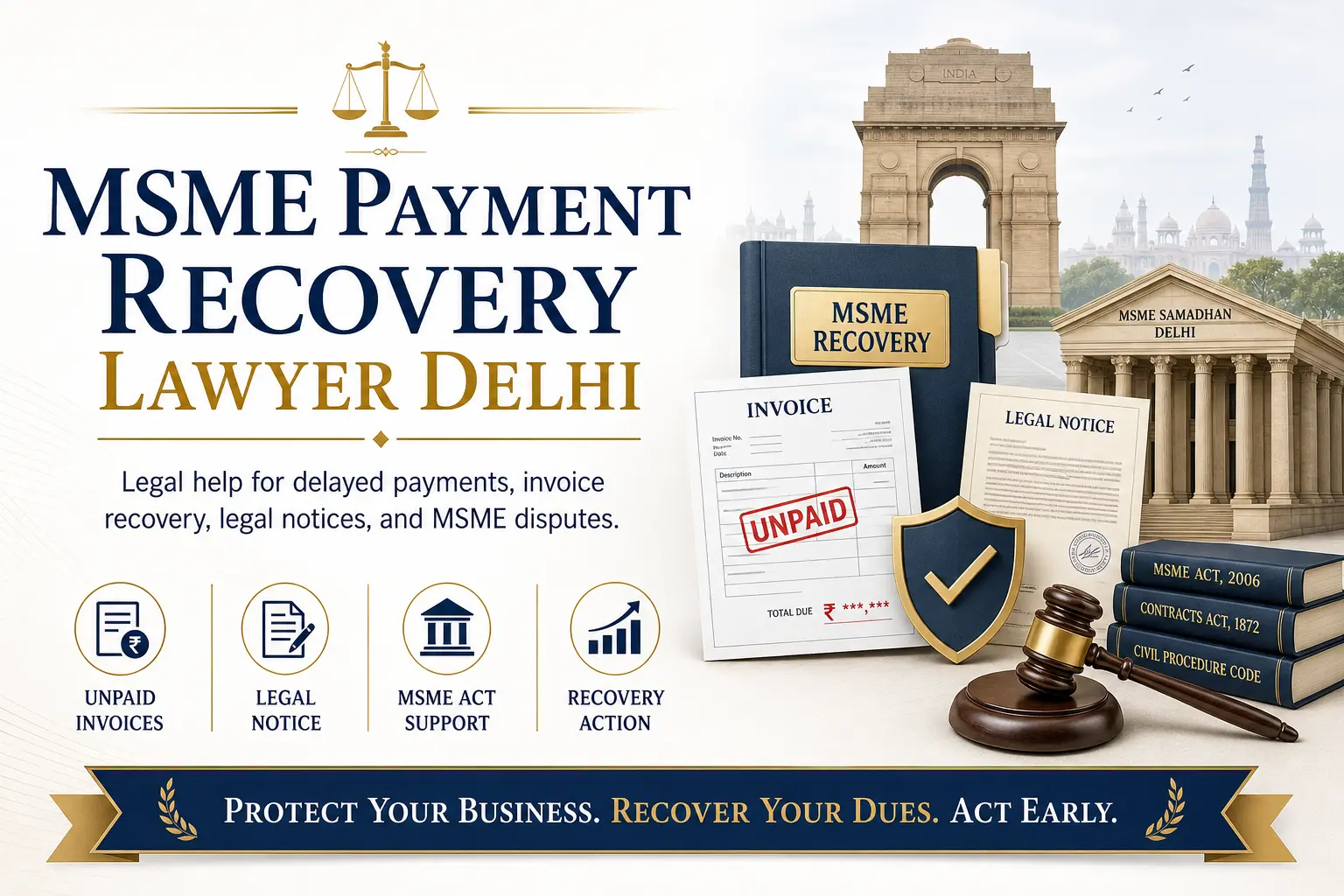
A delayed payment is not just an accounting entry. For a small business, it can stop salaries, disturb GST filings, block raw material purchase, and quietly damage the owner’s peace of mind. Many Delhi NCR suppliers keep following up for months because they don’t want to “spoil the relationship” with a buyer. Then one day the buyer stops replying, disputes the invoice, asks for unnecessary documents, or says the finance team will “check and revert”. By then, the MSME owner has already lost time, working capital, and confidence. That is where an MSME payment recovery lawyer Delhi becomes useful. Not because every unpaid invoice must immediately become litigation. Good legal action often starts with clarity: whether the enterprise was properly registered, whether the invoice falls under MSMED Act protection, whether a legal notice should be sent first, whether MSME Samadhaan or MSEFC proceedings are suitable, and whether settlement can still be structured without weakening the claim. For a micro or small supplier in Delhi, New Delhi, Noida, Ghaziabad, Gurugram, Faridabad, Greater Noida, Meerut, Hapur and nearby business hubs, delayed payment is usually more than one transaction. It affects staff, creditors, vendors, family cash flow and business reputation. I have seen small units wait six months for a payment that should have come in thirty days. By the time they approach a lawyer, the buyer has already built a paper trail against them. The aim of this article is simple: to explain how MSME payment recovery works in India, what Delhi-based suppliers should do before filing a claim, how the MSMED Act helps, where MSME Samadhaan and the Micro and Small Enterprises Facilitation Council fit in, and how Advocate BK Singh through msme lawyers can assist with notices, claims, documentation, settlement discussions and MSEFC representation. Delhi NCR has thousands of suppliers, service providers, fabricators, consultants, traders, logistics vendors, IT service units, packaging businesses, contractors and professional service firms working with corporate buyers, government departments, builders, manufacturers, hospitals, schools, retailers and startups. A single unpaid invoice can disturb the entire cycle. For many MSMEs, delayed payment does not look dramatic on day one. The buyer says payment is under process. Then comes a GST mismatch, a quality objection, a “management approval” excuse, or a request to revise the bill. Weeks pass. The supplier keeps calling. Staff salaries and rent don’t wait. A Delhi-based MSME has some special practical concerns. Buyers may be located in Noida, Gurugram, Faridabad, Ghaziabad or another State, while the supplier operates from Delhi. Documents may be spread across email, WhatsApp, purchase orders, e-way bills, delivery challans, GST invoices and ledger statements. Many business owners don’t know which forum applies or whether they should send a commercial legal notice, file on MSME Samadhaan, approach MSEFC, consider arbitration, or file a commercial recovery suit. The MSMED Act, 2006 gives micro and small suppliers a statutory route for delayed payments. India Code identifies the Micro, Small and Medium Enterprises Development Act, 2006 as Act No. 27 of 2006, enacted to support promotion, development and competitiveness of MSMEs. For Delhi NCR businesses in 2026, early legal action matters because documentation becomes weaker with delay. Employees leave. Emails get buried. Buyer-side staff change. Accounts teams deny oral assurances. Old WhatsApp chats become difficult to present cleanly. The strongest MSME recovery cases are not always the largest ones. They are the ones where documents, invoices, acceptance proof, delivery record and demand communication are properly arranged before the buyer creates confusion. MSME payment recovery means taking lawful steps to recover unpaid invoices, delayed bills, outstanding supply amounts, service charges or business dues owed to a registered micro or small enterprise. The route may include legal notice, negotiation, MSME Samadhaan filing, MSEFC conciliation, arbitration, commercial recovery action or settlement documentation. A normal unpaid invoice dispute and an MSME delayed payment claim are not always the same. A regular business recovery matter usually depends on contract terms, invoices, acknowledgements, limitation and civil recovery principles. An MSME delayed payment matter may also involve statutory protection under the MSMED Act if the supplier qualifies and the transaction fits the legal requirement. Most clients get this wrong because they assume registration alone wins the case. It doesn’t. Registration helps only when the documents show supply of goods or rendering of services, acceptance by the buyer, non-payment, and a legally recoverable amount. The buyer may still raise objections. Those objections may be weak, false, afterthought-based or genuine. A lawyer’s role is to test the record before filing. For Delhi MSMEs, the first question is usually not “Can we file a case?” The better question is: what is the strongest lawful route based on our documents, buyer conduct, invoice date, registration status and commercial objective? The main law for delayed payment recovery by micro and small enterprises is the Micro, Small and Medium Enterprises Development Act, 2006. The important provisions for payment recovery usually fall under Sections 15 to 24. Section 15 deals with the buyer’s liability to make payment within the agreed period, subject to the statutory ceiling. Section 16 deals with interest on delayed payment. Section 17 makes the buyer liable for the amount along with interest. Section 18 provides the MSEFC reference mechanism. Section 24 gives overriding effect to the delayed payment provisions. Section 17 states that for goods supplied or services rendered by the supplier, the buyer is liable to pay the amount with interest as provided under Section 16. A buyer cannot keep a micro or small supplier waiting endlessly. Where goods or services have been supplied and accepted, payment must be made within the agreed period, but that agreed period cannot legally exceed the statutory outer limit under the MSMED framework. A contract clause giving the buyer ninety days, one hundred twenty days or payment “as per company policy” may not automatically defeat the statutory protection available to an eligible supplier. Actual facts still matter. Delivery, acceptance, invoice date, written terms, buyer conduct and dispute timing must be checked. Delayed payment under the MSMED Act is not merely a principal recovery claim. Section 16 creates statutory interest liability where the buyer fails to pay as required. The interest provision is strict because the law recognizes that delayed payments can choke small businesses. This is why buyers often take an MSME notice seriously when it is drafted properly. A vague threatening notice may be ignored. A focused notice based on invoices, delivery proof, registration status, delay period and statutory interest is harder to brush aside. The Micro and Small Enterprises Facilitation Council route is designed to address delayed payment disputes involving micro and small suppliers. MSME Samadhaan helps suppliers file online applications, but action on the application is taken by the concerned MSEFC, not by the Ministry of MSME itself. The process generally begins with reference and conciliation. If conciliation does not resolve the matter, the dispute may move to arbitration under the statutory mechanism. This route needs careful claim drafting because the supplier’s documents, amount calculation, interest claim, buyer details and transaction chronology must be presented coherently. Section 24 is significant because it gives overriding effect to Sections 15 to 23 of the MSMED Act over inconsistent provisions in other laws. For practical purposes, this means buyers cannot casually rely on conflicting contract clauses to dilute statutory delayed payment rights. Yet every case still needs legal assessment. Arbitration clauses, jurisdiction clauses, quality disputes, limitation objections and registration timing can affect strategy. Not every MSME payment dispute must go to MSEFC. In some matters, a commercial suit, summary recovery action, arbitration under contract, insolvency-related assessment, or negotiated settlement may be more suitable. The right route depends on the amount, documents, buyer profile, urgency, relationship value, limitation status and enforceability. A supplier should not choose a forum only because someone said “MSME Samadhaan is easy”. Easy filing is not the same as strong recovery. A supplier should consider legal guidance when payment delay starts affecting cash flow or when the buyer’s excuses begin changing. One missed due date may be manageable. Repeated silence, disputed invoices, debit notes, forced deductions, quality allegations or partial payments without clarity need attention. This guidance is especially useful for: Small businesses usually approach a lawyer late. They first call the buyer, then send polite reminders, then ask a common friend to intervene. By the time the matter becomes serious, the buyer may have already created an excuse: poor quality, delayed supply, incomplete service, wrong billing, no purchase order, no acceptance, no authority, or “accounts reconciliation pending”. Early advice helps prevent that trap. MSME payment recovery should start with document review, not anger. A strong legal response comes from a clean paper trail: registration, supply proof, invoice, acceptance, reminders, ledger and buyer communication. The supplier must first check whether it had valid Udyam Registration before the disputed invoice date. The MSME Samadhaan FAQ states that Udyam Registration is mandatory for delayed payment benefits and that prior registration before the disputed invoice is required for filing an application. A lawyer will usually examine the registration certificate, invoice dates, nature of supply and buyer details. If registration was obtained after the transaction, strategy may need adjustment. Invoices alone are not enough in many cases. The supplier should collect purchase orders, work orders, email approvals, WhatsApp confirmations, delivery challans, e-way bills, GST returns, transport receipts, completion certificates, service reports, ledger statements and bank entries. For service businesses, acceptance is often shown through email trails, usage records, monthly approvals, continued engagement or part payments. In practice, these details can decide the strength of the case. A legal notice should not sound like a random threat. It should state the transaction, invoice details, due amount, delay, legal basis, prior follow-ups, demand for payment, interest position and time for response. For many Delhi MSMEs, a properly drafted MSME payment dispute notice by an advocate brings the buyer to the table. Buyers often ignore casual reminders but respond when the notice shows statutory consequences and document-backed seriousness. Settlement is not weakness. A structured settlement can save time, preserve business reputation and secure payment faster. The problem arises when MSMEs accept vague assurances without written terms. Any settlement should record the principal amount, payment schedule, default consequence, interest position, mode of payment, cheque or bank transfer details, and what happens if the buyer fails again. Oral settlement is risky. A short written settlement can prevent a second dispute. Where notice and negotiation fail, the supplier may consider MSME Samadhaan filing or MSEFC proceedings. The claim must be supported by documents, invoice-wise amount, interest calculation and buyer details. Businesses looking for MSME Samadhaan legal expert assistance should focus on claim quality, not just portal submission. Poorly prepared filings can create delay, objections and avoidable procedural difficulty. MSEFC proceedings commonly involve conciliation first. If settlement does not happen, arbitration may follow under the statutory route. Representation at this stage requires clarity on facts, documents, amount, interest, buyer objections and relief sought. A Delhi supplier dealing with a buyer in another State should not assume the matter becomes impossible. MSMED Act jurisdiction has its own statutory design. The exact forum and filing approach should be checked with the factual record. Documentation is the backbone of an MSME delayed payment claim. Even a genuine supplier can face difficulty if the record is scattered, incomplete or inconsistent. Keep these documents ready: For unpaid invoice cases, a lawyer may also prepare an invoice-wise chart. This chart usually records invoice number, date, amount, due date, payment received, balance outstanding and interest claim. Simple. But powerful. A supplier preparing for MSME notice for unpaid invoice should never send a notice before checking whether invoice numbers, dates and amounts match the ledger and GST records. MSME delayed payment matters have two timelines: the legal timeline and the practical business timeline. The legal timeline concerns due dates, limitation, notice, filing and proceedings. The business timeline concerns cash flow, staff payments, vendor pressure and buyer relationship. The MSMED framework recognizes a payment discipline where the buyer cannot stretch payment beyond the statutory ceiling. Still, a supplier should not wait endlessly just because the law provides a remedy. This period is critical for reminders, reconciliation and written acknowledgement. If the buyer raises a genuine issue, resolve it in writing. If the buyer only asks for time, record the extension clearly without waiving rights. Once payment crosses the statutory threshold, the supplier should take the matter seriously. A legal notice may be suitable if reminders have failed. Delay beyond this stage gives the buyer more room to create objections. Many MSMEs lose negotiating strength during this period because they keep depending on verbal assurances. A buyer who has not paid for months should be handled through written communication. Limitation depends on the nature of claim, acknowledgements, payments, contract terms and facts. Do not assume an old invoice is automatically dead. Do not assume it is automatically recoverable either. Part payments, written acknowledgements and account confirmations may affect the calculation. MSEFC matters are intended to provide a focused statutory route, but actual timelines may vary depending on council workload, buyer response, documentation, adjournments, conciliation efforts and arbitration stage. A lawyer should be honest about this. No ethical advocate can promise a fixed recovery date. Business owners often damage good claims without realizing it. Most mistakes happen before the lawyer enters the picture. A polite reminder is fine. Ten polite reminders without legal action may weaken urgency. Buyers take silence as comfort. Messages like “please understand my problem” may be human, but they don’t build a legal claim. Demand communication should remain professional and document-based. Many suppliers register after payment default and assume old invoices are covered. Registration timing needs careful review before filing. If the buyer alleges quality issue or incomplete work, respond with documents. Silence can later be used against the supplier. Large groups often have several companies. Invoice raised on one entity cannot be casually demanded from another unless documents support liability. A badly drafted notice may give the buyer a preview of your weak points. Strong notices are precise, not loud. Statutory interest should be calculated carefully. A vague inflated figure can invite objections. Portal filing is not a formality. Missing documents can slow down the matter. Part payment may help, but it should be recorded properly. Otherwise, the buyer may later dispute the balance. Most MSME payment disputes are civil or commercial in nature. Criminal allegations should not be casually used unless facts genuinely support such action. Ignoring payment default rarely protects the relationship. It usually protects the buyer. The first risk is cash-flow damage. MSMEs survive on rotation. One unpaid bill can block three future orders. Rent, salaries, GST, loan EMIs and vendor dues pile up quickly. The second risk is evidence loss. Old employees leave. Delivery acknowledgements go missing. Emails get buried. WhatsApp chats are deleted. Buyers change their stand. What was once simple becomes disputed. A third risk is limitation. Delay can create legal complications. Even where some remedy remains, the supplier may have to spend more effort explaining delay. Reputation risk also matters. If a small supplier cannot recover dues, it may start defaulting toward its own vendors. That creates market distrust. One more risk is emotional fatigue. Business owners often feel embarrassed to chase money. They avoid calls, delay salaries, borrow informally and carry stress home. Legal structure helps because it moves the matter from personal pleading to formal recovery. If the buyer has already denied liability or raised a quality dispute, quick legal review becomes more urgent. A Delhi-based supplier can consult an MSME dispute resolution lawyer to assess whether negotiation, notice, MSEFC filing or another recovery route is more suitable. Consult a lawyer when the buyer stops giving clear payment dates, starts disputing the work after using the goods or services, asks for unjustified deductions, or delays payment beyond the agreed credit period. A lawyer should also be consulted when: A good lawyer will not blindly file the case on day one. First comes document review. Then route selection. Then notice or claim. That order matters. msme lawyers assists suppliers, vendors, service providers and business owners in evaluating unpaid invoice disputes, preparing legal notices, filing MSME Samadhaan applications, handling MSEFC matters, exploring settlement and taking suitable recovery action. Advocate BK Singh works with MSME clients who need practical legal support, not confusing legal jargon. The focus is on facts, documents, lawful pressure and commercially sensible action. Depending on the matter, assistance may include: If your dispute is still at the notice stage, you may explore MSME legal notice support for payment disputes. If the matter has already crossed the portal or council stage, a more formal claim strategy may be required. For businesses in Ghaziabad and nearby industrial zones, location-specific help is also available through MSME payment recovery lawyer Ghaziabad and MSME lawyers in Ghaziabad. For Greater Noida suppliers, MSME lawyers in Greater Noida may be relevant. Delhi-based clients who want broader local assistance can also review MSME dispute advocate near me, especially where the dispute involves a nearby buyer, local business dealing or recurring unpaid invoices. An MSME payment recovery lawyer in Delhi helps micro and small enterprises recover unpaid invoices, delayed payments, outstanding business dues and statutory interest through legal notices, negotiation, MSME Samadhaan filing, MSEFC proceedings, settlement or suitable commercial recovery action. Yes, eligible micro and small enterprises can file delayed payment applications through MSME Samadhaan. The portal forwards applications to the concerned MSEFC. The Ministry of MSME does not itself decide the claim. Yes, Udyam Registration is treated as mandatory for availing delayed payment benefits through MSME Samadhaan. Registration timing is important, especially where the disputed invoice predates the registration. Yes, the MSMED Act provides for statutory interest on delayed payments where the buyer fails to pay as required. Interest calculation should be done carefully because wrong or vague calculation can invite objections. In many cases, a legal notice helps create a formal demand record and may lead to settlement. It is not a substitute for proper filing, but it can be a strong first step when drafted with invoice details, legal basis and payment demand. Late quality objections must be examined carefully. The supplier should collect delivery proof, acceptance emails, usage records, part payment details, inspection notes and prior communications to show whether the objection is genuine or an afterthought. Yes, MSME delayed payment disputes can involve buyers outside Delhi. The correct forum and jurisdictional approach should be assessed based on supplier location, buyer location, contract terms and MSMED Act provisions. Most unpaid invoice and delayed payment matters are civil or commercial disputes. Criminal action should not be casually threatened unless the facts support a genuine criminal element such as dishonest intention from the beginning. Timelines vary based on forum workload, documents, buyer response, conciliation efforts, arbitration stage and settlement possibility. A lawyer can estimate practical movement after reviewing the case record, but no fixed recovery date can be guaranteed. Yes, Advocate BK Singh through msmelawyers.com can assist with MSME payment recovery notices, MSME Samadhaan filing support, MSEFC claim preparation, conciliation, arbitration-stage assistance and settlement documentation. Delayed payment is one of the most common problems faced by small businesses in Delhi NCR. Many suppliers keep waiting because they fear losing future work. That fear is understandable. But silence should not become a business policy. A strong MSME recovery strategy begins with clean documents, correct registration review, proper legal notice, careful interest calculation and forum selection. Sometimes the matter can settle. Sometimes MSEFC action becomes necessary. Sometimes a commercial recovery route fits better. The answer depends on facts. If you are a supplier, vendor, contractor or service provider waiting for unpaid invoices, speak to an MSME payment recovery lawyer Delhi before the dispute becomes older, weaker and harder to prove. Advocate BK Singh and msme lawyers can help you assess the right legal step with professional restraint and practical clarity.MSME Payment Recovery Lawyer in Delhi
Why MSME Payment Recovery Matters in Delhi NCR in 2026
Quick Facts Box
What Is MSME Payment Recovery in Simple Words?
Legal Framework for MSME Payment Recovery in India
Section 15: Payment Cannot Be Delayed Indefinitely
Section 16: Statutory Interest Is a Serious Pressure Point
Section 18: MSEFC Conciliation and Arbitration Route
Section 24: Overriding Effect
Commercial Courts and Civil Recovery
Who Needs Guidance from an MSME Payment Recovery Lawyer Delhi?
How Does the MSME Payment Recovery Process Work?
Stage One: Check MSME Status and Transaction Fit
Stage Two: Organise the Commercial Record
Stage Three: Send a Focused Legal Notice
Stage Four: Evaluate Settlement
Stage Five: File MSME Samadhaan or MSEFC Claim
Stage Six: Conciliation, Arbitration and Follow-up
Documents and Evidence Checklist for MSME Recovery
Document Why it matters Udyam Registration Certificate Shows MSME status and timing of registration Purchase order or work order Establishes buyer’s request and agreed terms Tax invoices Shows billed amount, GST details and invoice dates Delivery challans or service proof Supports supply, completion or performance E-way bills and transport records Useful for goods supply disputes Email and WhatsApp approvals Helps prove acceptance and follow-ups Ledger account and statement Shows outstanding balance Bank statements Shows part payments, if any Debit notes or objections Helps assess buyer’s defence Prior reminders and notices Shows demand history and buyer conduct What Are the Timelines, Practical Delays and Decision Windows?
The First 15 to 45 Days
After 45 Days
Three to Six Months
Limitation Concerns
Practical Delay in Proceedings
Common Mistakes MSMEs Make in Payment Recovery Cases
Waiting Too Long
Sending Emotional Messages
Not Checking Udyam Registration Timing
Ignoring Written Objections
Mixing Multiple Buyer Entities
Sending a Weak Legal Notice
Claiming Wrong Interest Without Calculation
Filing Without Proper Annexures
Accepting Part Payment Without Written Terms
Treating Every Dispute as Criminal
What Are the Risks of Ignoring MSME Payment Default?
When Should You Consult an MSME Payment Recovery Lawyer?
How msme lawyers Can Help in MSME Payment Recovery Matters
Frequently Asked Questions
1. Who is an MSME payment recovery lawyer in Delhi?
2. Can an MSME recover delayed payment through MSME Samadhaan?
3. Is Udyam Registration required for MSME delayed payment claims?
4. Can I claim interest on delayed MSME payments?
5. Should I send a legal notice before filing MSME Samadhaan?
6. What if the buyer says goods were defective after using them?
7. Can a Delhi MSME file against a buyer located in another State?
8. Is MSME payment recovery a civil or criminal matter?
9. How long does an MSME recovery case take?
10. Can Advocate BK Singh help with MSME Samadhaan and MSEFC cases?
Final Thoughts
Table of Contents
There's no reason for concern. There is no difficult-to-understand legalese.
Someone who has helped many people with the same problems gives you clear, honest advice. We want to make the legal process easy to understand and use for everyone.