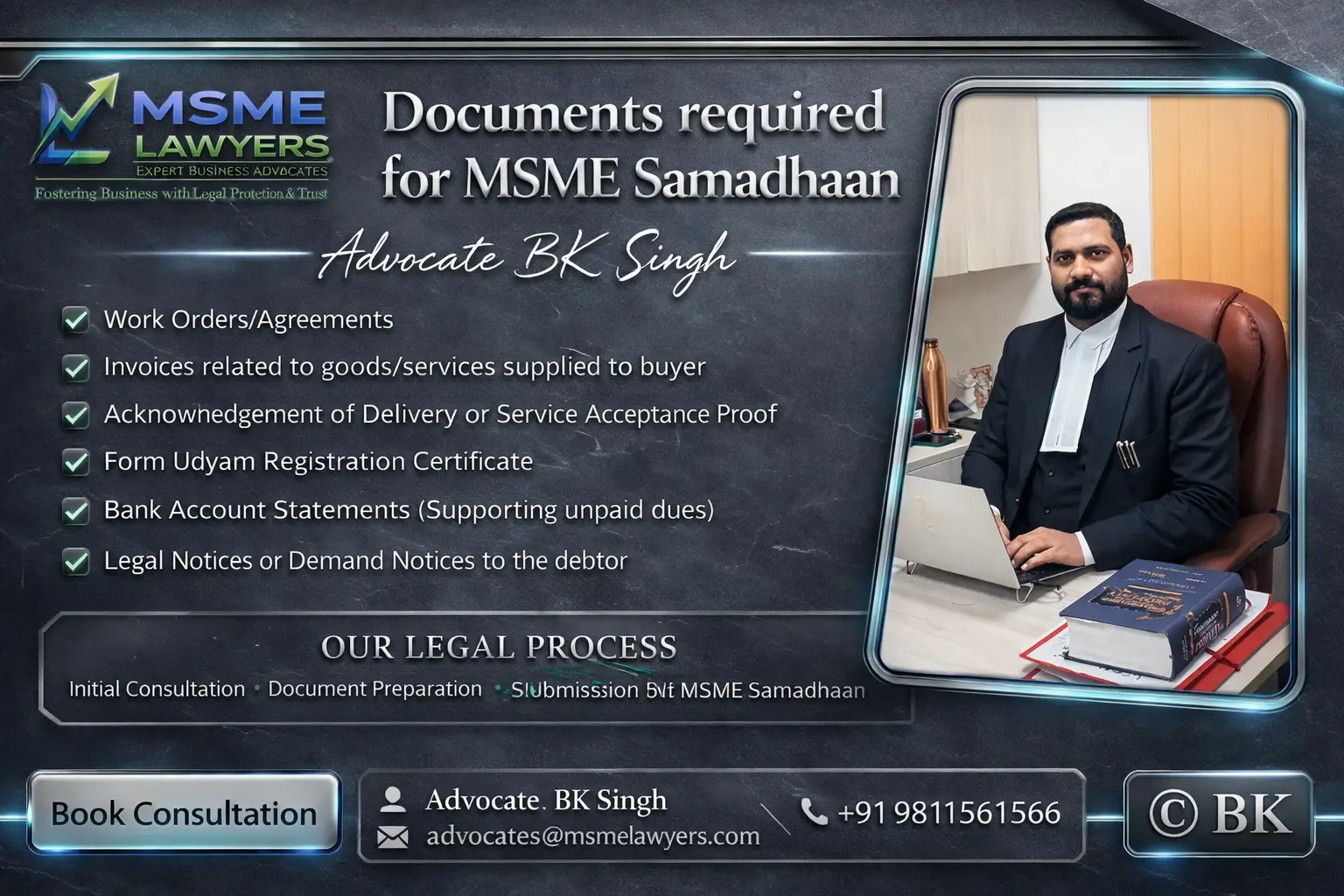
Documents required for MSME Samadhaan
When a small Indian business finishes a job, sends an invoice, and still doesn't get paid, the stress isn't just financial. It has an impact on salaries, buying raw materials, vendor trust, and the business's ability to stay in business every day. This is why the problem of late payment under the MSMED Act is one of the most searched for issues by business owners, service providers, manufacturers, traders, and family-run businesses. In real life, micro and small businesses use MSME Samadhaan to take disputes over late payments to the Facilitation Council. The current official system also sends new applications for late payments to the MSME ODR Portal for filing. Sections 15 to 24 of the MSMED Act talk about late payments, and official advice says that Udyam registration is required, that registering before the disputed invoice matters, and that work order support is important when filing.
In real life, the first problem is usually not the law but the paperwork. A lot of businesses know that money is stuck, but they don't know which papers to use to make a strong claim for a delayed payment. This is where careful record-keeping becomes the case's base. MSME Lawyers and Advocate BK Singh usually start by checking if the claimant is a micro or small business for the time period in question, if the invoice date meets the registration requirement, and if the claim file has the commercial documents that clearly show the supply of goods or services, the payment terms, follow-up reminders, and the exact amount owed. A well-organized file saves time, cuts down on objections, and makes the buyer feel like they have to respond seriously.
1. Who can file under MSME Samadhaan?
MSME Samadhaan is for small and micro businesses that are having trouble getting paid on time by customers. It is clear from official guidance that Udyam Registration is required to get delayed payment benefits. If the business was not registered before the date of the disputed invoice, the benefit cannot be claimed for old invoices. This is a very important point because a lot of business owners first apply for registration after a dispute starts and then think they can get back all of their past dues through the same process. That mistake often makes the claim weaker right from the start.
For example, a fabric supplier in Delhi delivered goods in January but didn't get Udyam registration until March because the payment was late. If the invoice in question is from before the registration period, the filing could be very hard. If, on the other hand, a service provider already had a valid Udyam registration before sending out invoices and can show proper business records, the claim is much stronger. MSME Lawyers and Advocate BK Singh usually look at this timeline first because this one issue often decides whether the case moves forward smoothly or starts with unnecessary objections.
2. The most important papers needed for MSME Samadhaan
The main set of documents usually includes the Udyam Registration certificate, the purchase order or work order, the tax invoices, the proof of delivery or completion of service, and the statement showing the amount that is still owed. The official FAQ says that a work order is required, and if the purchase order was made orally, an affidavit must be filed to prove that. In some state processes, the official scheme guidance also talks about the printed claim application and supporting forms. This shows that paperwork is still important even after filing online.
In real life, useful supporting documents include copies of agreements, email chains, WhatsApp follow-ups, ledger accounts, bank statements showing that the buyer didn't receive the goods, GST documents, e-way bills when needed, proof of delivery, proof of installation, a completion certificate, or any other proof that the buyer received the goods. To a business owner, these records may seem normal, but when put together, they tell the story of the transaction. The stronger the document chain, the harder it is for the buyer to casually deny their responsibility for supply, quantity, quality, or payment. That is why MSME Lawyers and Advocate BK Singh see document arrangement as a claim strategy instead of just clerical work.
3. Why are purchase orders and work orders so important?
A purchase order or work order lets the Council know that the deal was not just a casual guess, but a formal business deal. It helps figure out who placed the order, what was delivered, what price was agreed upon, and whether the buyer agreed to the delivery times and business terms. The official FAQ says that a work order is required, and if there was an oral purchase order, the applicant must submit an affidavit. This means that parties shouldn't think that invoices will always be enough.
This is important in fields like construction support, custom fabrication, manpower services, packaging, printing, software support, logistics, and repair work, where business often starts with phone calls and messages. When it comes to these kinds of things, a well-written affidavit along with emails, chats, proof of dispatch, and an invoice history can help fill in the gaps. A lot of middle-class business owners and small businesses lose faith because they think that not having a formal contract means the end of the matter. The case can still move, but it needs to be presented in a disciplined way. This is where MSME Lawyers and Advocate BK Singh come in handy.
4. How delivery proof and ledger strengthen the claim
Invoices show how much is owed, but proof of delivery and proof of service show that the invoice is real. For goods, this could mean a delivery receipt, a transporter's receipt, e-way paperwork, a stock receipt, a gate entry, or a buyer's receipt. For services, it could include completion mail, usage confirmation, deployment sheet, milestone approval, attendance record, or invoice acceptance mail. When the invoice is linked to real execution material, the claim is much more believable.
A ledger statement is just as useful because it shows the running balance between the two parties and the exact amount that is still owed. When part payments were made, the ledger is often the best way to show what is still owed. In a lot of disagreements, the buyer doesn't deny the business relationship but instead questions the final balance. A clear ledger backed up by invoices and a record of payments can help clear up that confusion. MSME lawyers often use this combination to turn a vague complaint into a clear claim for late payment that the buyer can't easily get out of.
5. Emails that remind you and keep track of your conversations can change the case.
Emails that follow up, reminders, meeting notes, demand letters, and reply messages often tell the whole story of the disagreement. Even if the buyer later takes a defensive stance, earlier communications may show that they acknowledged the dues, asked for time, promised to pay part of the bill, or talked about the release schedule. These records are useful because they show that payment was due and asked for many times. In a lot of cases, they also show that the disagreement only happened after the demand for payment grew.
A buyer might later say that the quality is bad, but emails from before may show that they were repeatedly told that payment would be released after internal approval. That difference is important. It helps the person who is suing show that the defense is an afterthought. These messages are often not taken seriously by small businesses because they are too busy running the business. Advocate BK Singh usually tells clients to keep all of their payment reminders, acknowledgments, and business replies because these records can make a big difference between a weak complaint and a strong claim file.
6. Practical tips for the current filing route and portal
The official Samadhaan platform now clearly says that new applications for delayed payments should be sent to the MSME ODR Portal. The Samadhaan system still gives information about cases and their status, but new filings are now done through the updated online route. The official instructions also say that the registered email in Udyam is important because that's where OTP communication is sent and where you can upload multiple invoices as one PDF. These practical points are important because problems with filing often come from email mismatches or poorly prepared documents, not from the legal claim itself.
Before filing, businesses should make sure that the Udyam information is up to date, the registered email is working, the invoice files are readable, and the combined PDFs are in the right order by date. Even if there are a lot of invoices, the file should still be neat, with a cover page that shows the total amount owed and the supporting documents in a logical order. This kind of planning helps things go more quickly. For many people who are filing a claim for the first time, working with MSME Lawyers is helpful because the filing process seems complicated. However, once the documents are in the right order, it is much easier to handle.
7. Common mistakes that make msme samadhaan claims weaker
One mistake that happens a lot is filing without checking to see if the business was registered before the invoice that is in question. Another is only using invoices and not showing a purchase order, work order, proof of delivery, or a record of communication. Some businesses also upload documents that are hard to read, have names that aren't clear, or are missing pages. This makes the case look weaker than it really is. Some people wait too long, which makes the business history messy, with account statements that aren't clear and follow-up that isn't consistent. Official FAQ guidance already makes it clear what kind of documents are needed, so ignoring them is a risk that can be avoided.
Another mistake is thinking that every payment dispute is automatically a strong legal claim. The case must be carefully prepared if there are quality disputes, return issues, credit note adjustments, or unclear acceptance records. This is why it's usually better to have a legal review before filing than to rush to file. Advocate BK Singh's main goal is to find gaps in documents ahead of time so that the claimant knows exactly what to expect when they start the process. This careful approach can save small businesses money and time because they can't afford to make the same mistakes over and over.
8. How legal help can help small businesses make a stronger case
The hardest part for many business owners is not writing one complaint but telling the whole story of their business in a way that the Council can quickly understand. Legal help can help you sort through papers, check the registration timeline, figure out how much money you owe, find missing commercial proof, and avoid making statements in the application that could hurt you. It also helps the person making the claim figure out which documents they really need and which ones are just emotional complaints. That discipline is important because clear and consistent behavior, not just anger, wins cases where payments are late.
MSME Lawyers and Advocate BK Singh help their clients by turning scattered invoices, ledger extracts, emails, and order papers into a structured claim file that shows that the claim is serious and trustworthy in business. This is especially useful for small business owners, family-run businesses, service providers, consultants, manufacturers, and local suppliers who can't afford to have their cash flow interrupted for a long time. A well-prepared MSME Samadhaan matter does more than just ask for money. It helps the business get its confidence back, protect its working capital, and deal with buyers who don't pay up from a strong legal position instead of a weak one.
Reviews from Clients
*****
Rohit Mehra
I had money owed to me by a buyer for months, and I was completely stuck because I didn't know which documents I needed for MSME Samadhaan. MSME Lawyers went through the file with me step by step, helped me organize my invoices and work order, and made sure I knew what was missing before I filed. Advocate BK Singh gave me clear advice without making any false promises, and that honesty gave me confidence from the start.
*****
Neha Arora
The hardest part for me was figuring out the difference between a purchase order and proof of service. I thought my invoices were enough, but the team helped me make a much stronger file by adding communication records and an account statement. The advice seemed useful and doable. Finally, I felt like someone understood how hard it is for small businesses when payments are late.
*****
Sandeep Khurana
I run a small business, and every late payment affects my salary and stock purchases. The calm and organized way they went about things was what I liked best. MSME lawyers didn't make things harder by using big words. Advocate BK Singh went over the papers very carefully and told me exactly what would help and what wouldn't. It's not often that things are this clear.
*****
Pooja Bansal
I went to them because I was worried that my paperwork wasn't complete. They didn't rush me; instead, they checked my Udyam position, invoice dates, and the trail of communication. The support staff seemed to care about the client and their needs. I was finally able to move forward with confidence instead of just sending the buyer a lot of reminders.
*****
Amitesh Verma
The best part of the experience was that they took my case seriously, even though I am not a big company. As a small business owner, the pressure on my cash flow was getting too much to handle. MSME Lawyers explained the process of delayed payment to me in plain English, and Advocate BK Singh helped me with the paperwork in a way that made me feel like the case was ready.
?FAQs
Q1. What papers do you need to file for MSME Samadhaan?
Udyam Registration, a purchase order or work order, invoices, proof of delivery or service, a ledger statement, and communication about payment follow-up are all usually part of the basic document set. You might need an affidavit if the order was given verbally. Official advice makes it clear that work orders are important.
Q2. Is it necessary for MSME Samadhaan to register with Udyam?
Yes. According to the official FAQ, Udyam Registration is required to get benefits for late payments. The registration timeline is also important because you can't claim benefits for invoices that were sent before you registered.
Q3. Can I file if I got my Udyam Registration after the invoice date?
That can be hard. According to official rules, registering before the date of the disputed invoice is important. Before filing, you should carefully check this issue because many claims fall apart on this point alone.
Q4. Do MSME Samadhaan matters require a purchase order?
The official FAQ says that a work order is required. If the purchase order was made verbally, the applicant can send in an affidavit saying so along with other proof.
Q5. Can you file more than one invoice at once?
Yes. The official FAQ says that you can combine several invoices into one PDF and upload it. It's best to sort them by date and give a clear summary of the amounts.
Q6. Where do people now file new applications for delayed payments?
According to the official system, new applications for delayed payments must now be made through the MSME ODR Portal. The Samadhaan system still shows information and advice about cases.
Q7. What if the buyer and seller don't have a written contract?
A written contract is helpful, but not having one doesn't always mean the end of the matter. Depending on the facts, work orders, accepted quotes, emails, WhatsApp chats, invoices, proof of delivery, and affidavits for oral orders may still support the claim.
Q8. Can service providers also use MSME Samadhaan?
Yes, as long as they are micro or small businesses and the transaction meets the legal requirements. To back up their claim, service providers should keep copies of work orders, completion records, invoices, and payment reminders.
Q9. What is the most common reason why a delayed payment claim loses its strength?
Late Udyam registration, missing work orders, poor invoice support, unclear outstanding amount, and no records of communication are the most common reasons. Filing quickly with missing papers often makes things harder than they need to be.
Q10. Why should I get legal help before I file MSME Samadhaan?
Before filing, legal help can save you time by checking your eligibility, filling in any gaps in your documents, the timeline for your invoices, your registration status, and the presentation of your claim. For small businesses, that early review often stops technical errors that would make the case take longer.
There's no reason for concern. There is no difficult-to-understand legalese.
Someone who has helped many people with the same problems gives you clear, honest advice. We want to make the legal process easy to understand and use for everyone.