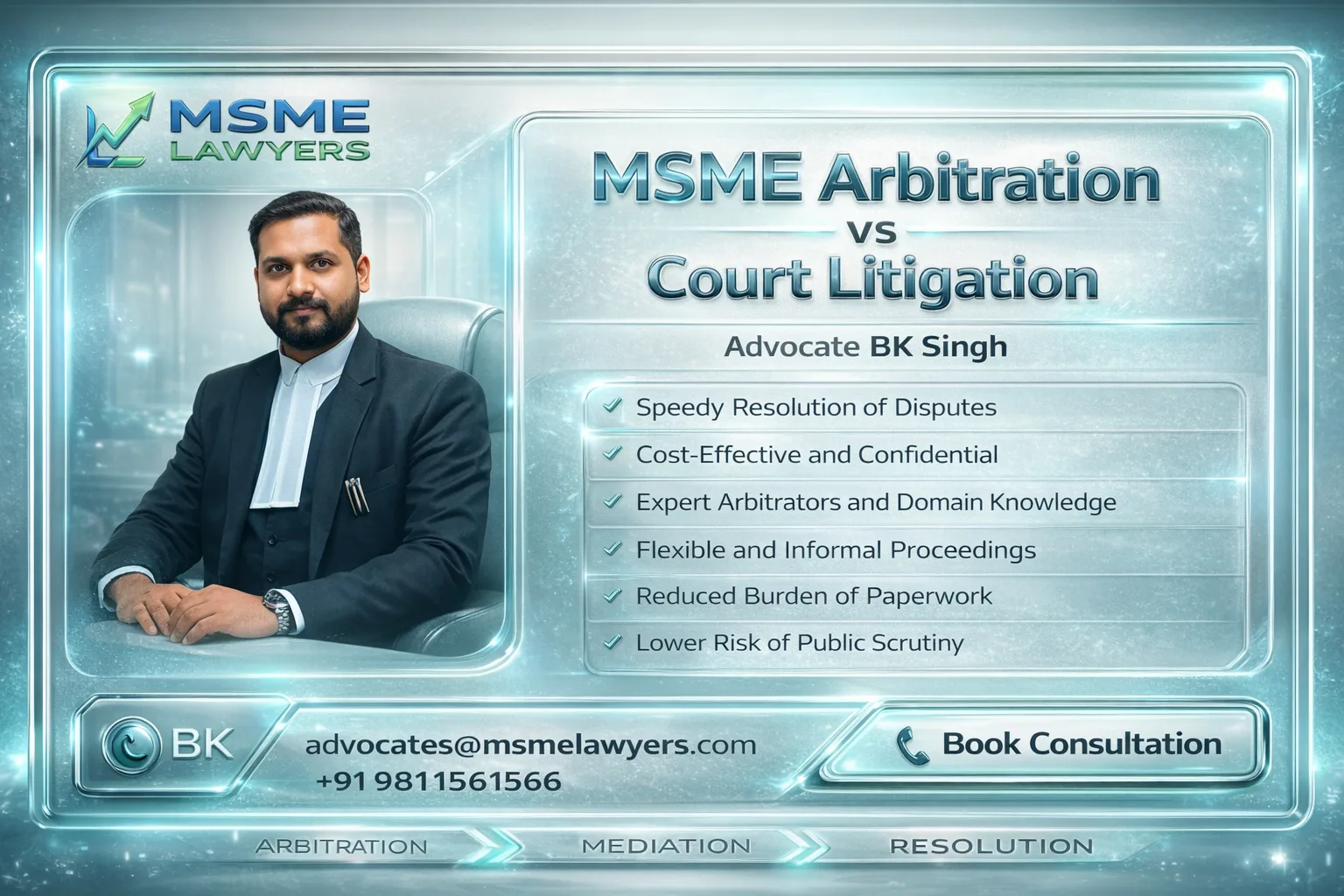
MSME Arbitration vs Court Litigation
When a small business is in a payment dispute, the most important question is usually not about the law. It's about staying alive. The owner wants to know which way is quicker, safer, and more useful. The Micro and Small Enterprises Facilitation Council is often the place where MSME disputes go in India. The law protects late payments in special ways, such as allowing a maximum agreed credit period of 45 days and interest at three times the RBI bank rate with monthly compounding in certain cases. That's why a lot of business owners look at MSME arbitration and a regular civil court case side by side before making a decision.
Most real delayed payment cases are better handled by MSME arbitration than by going to court. This is because arbitration is meant to help the parties reach an agreement first and then go to arbitration if that doesn't work. The system is supposed to speed things up, keep the focus on unpaid debts, and give small suppliers a better way to get their money back. At the same time, going to court can still be useful in some cases, especially when the disagreement is bigger, the evidence is hotly contested, or the issue goes beyond a simple claim for invoices and service dues. This is where MSME Lawyers and Advocate BK Singh can help clients pick the right path for their case instead of wasting months on the wrong one.
1. What does msmE arbitration usually mean in India?
MSME arbitration is a term that most people in business use to talk about the process that eligible micro and small businesses can use to settle payment disputes under the MSMED Act. If a supplier has a valid Udyam registration, they can go to the Facilitation Council. The council may first try to settle the issue. If that doesn't work, the issue can go to arbitration, either with the council itself or with a third-party institution. This is not the same as a standard private commercial arbitration clause that is used in big contracts.
This difference is important because many business owners think that every case of an unpaid invoice must go to civil court right away. That isn't always the case. The MSME route can help a smaller supplier more directly when the claim fits the delayed payment framework. Advocate BK Singh often breaks this down for clients in simple terms. If you haven't paid for goods or services, the real question isn't just who is right in the eyes of the law. The real question is which forum puts the most pressure on you and shows you the clearest way to get better.
2. When it might still be necessary to go to court
Court litigation is more important when the disagreement is about more than just late payment. If one side says there was fraud, a serious breach of a bigger development contract, title-related disputes, injunction issues, or complicated counterclaims that need more evidence and more than one type of relief, a regular court may still be the best place to go. The MSME framework is useful, but the official FAQ makes it clear that the main goal of the delayed payment mechanism is not to look at pure breach of contract.
This is important for small businesses in India because a lot of disputes are mixed. The buyer may say the material was defective, rejected in time, or never matched the order, while the manufacturer may say the buyer unfairly withheld payment. If the rejection is real and sent right away, the problem might not just be a late payment. In these kinds of cases, taking the time to carefully review documents is more important than filing quickly. MSME Lawyers and Advocate BK Singh put a lot of emphasis on this early assessment so that clients don't have to go back and fix their strategy later.
3. Speed and useful timelines
Speed is one reason why people look for MSME arbitration so often. According to the Samadhaan system, every reference to the Facilitation Council must be resolved within ninety days of the date of reference under the Act. In reality, timelines can still be different from state to state and council to council. However, the law clearly shows that it wants to give smaller businesses a faster way to settle disputes than regular civil litigation, which can take much longer because of pleadings, evidence stages, repeated adjournments, and procedural applications.
A bakery supplier in Lucknow, a fabric unit in Surat, or a machine parts vendor in Faridabad can't usually wait years for a final answer. They need to get working capital back into circulation. This is why MSME arbitration is not just a legal option in many cases of delayed invoices. It helps businesses stay alive. BK Singh Advocate usually tells clients to think about their cash flow. The fastest way isn't always the best way, but when it comes to simple unpaid debts, speed is often the most important thing.
4. The strength of your bargaining power and the cost of things
Over time, court cases can get very expensive because the costs are not just the court fees or lawyer fees. It includes going to court multiple times, spending time managing the case, traveling, handling documents, and the slow drain of not knowing what will happen. Under the MSME framework, arbitration can also involve work and preparation. However, the structure often puts more commercial pressure on the parties much sooner, especially when the buyer knows that the law allows for a delayed payment remedy with heavy interest consequences.
That pressure to bargain is one of the best hidden benefits. When buyers find out that the supplier isn't just sending reminders but has also set up a legally protected recovery route, they take settlement more seriously. This often changes the way people talk during negotiations. MSME Lawyers is careful with this pressure point. The goal is not to make things worse. The goal is to get the other side to stop making excuses and choose a structured settlement, part payment, or a defendable final award path.
5. The msmed act's power and the protection of interests
The delayed payment rules are a big reason why MSME arbitration is often better for eligible suppliers than regular recovery litigation. The Ministry says that buyers must pay within the agreed time frame, which cannot be longer than 45 days. If they don't, they could be charged compound interest with monthly rests at three times the RBI bank rate. That interest framework can make the claim worth a lot more or a lot less, and it can also make buyers less likely to drag their feet.
This isn't a technical issue for a small business. It can choose whether or not to continue with the dispute. In many real-life situations, the principal amount alone may not fully show how much damage was done by late payment. The company may have borrowed money, missed payroll, delayed payments to vendors, or lost stock rotation. Advocate BK Singh usually tells clients that the MSMED Act is strong because it understands that late payments hurt small businesses in ways that go beyond just the unpaid bill.
6. Papers that often make the decision
A lot of business owners think they need a perfect formal contract to get started. The official FAQ says that even if there isn't a formal purchase order, emails, delivery challans, part payment records, and acknowledgments on invoices can still be accepted. This is helpful for Indian MSMEs because many real business deals are based on WhatsApp messages, email confirmations, ledger balances, and invoice confirmations instead of long legal agreements.
Still, documents are what win cases. Good invoices, GST records, e way details when they apply, signed delivery proof, account statements, email follow-ups, and proof of acceptance can turn a weak dispute into a strong recovery matter. Before talking about aggressive legal steps, MSME Lawyers and BK Singh Advocate usually start with paperwork. A client may be emotionally ready to fight, but the outcome often depends on how well the documents are organized and whether the story of the transaction can be told clearly from beginning to end.
7. The problem of the 75% deposit and the risk of challenge
Section 19 is one of the most important reasons why buyers take MSME awards seriously. The Samadhaan portal and India Code both show that a non-supplier appellant who wants to challenge an award or order under this framework must pay a 75% deposit before the court will hear the case. That is a big pressure point, and it often changes the economics of delaying tactics after an award.
For suppliers, this can give them more power in negotiations after they win a contract. For buyers, it's a warning that a casual defense strategy can quickly become expensive. This doesn't mean that every MSME claimant will win, and it doesn't mean that they don't have to prepare their case carefully. But it does show why MSME arbitration is often better than a regular money recovery lawsuit. Advocate BK Singh often uses this stage to get people to talk about settling the case in a way that makes sense before it turns into a long and costly legal battle.
8. Which choice is better for small businesses?
MSME arbitration is often the best first choice for a simple unpaid dues claim from a qualified micro or small business because it is designed to handle disputes over late payments, is backed by statutory interest, and is meant to be resolved faster than a regular court case. It also starts with conciliation, which gives both sides a chance to reach an agreement before the case becomes fully adversarial.
If the disagreement is very factual, involves bigger contract problems than just late payments, or needs more help than just a focused recovery claim, going to court may still be better. So, the real answer is that court doesn't always win over arbitration. The best answer is that the type of dispute should decide where it should be heard. For a lot of small business owners and middle-class entrepreneurs, the best thing to do is have MSME Lawyers and Advocate BK Singh check the papers early so they can choose the path that saves them both time and money.
Reviews from Clients
*****
Ritesh Malhotra
I chased a business buyer for months and didn't get anywhere. Advocate BK Singh broke down the MSME route in simple terms and helped me see why arbitration was better than filing a long civil recovery case. The advice was useful, the paperwork was done well, and I finally felt like my small business had someone who cared about it.
*****
Neha Bansal
The clarity was what I liked best. MSME lawyers didn't make up promises. They looked over my emails, invoices, and ledger entries and told me honestly what was good and what needed help. That level of openness made me less stressed and gave me the confidence to move forward.
*****
Faizan Qureshi
I didn't know if my case should go to court or the MSME forum. BK Singh Advocate explained it to me step by step so I wouldn't make a mistake in court. The team stayed in touch and gave me a clear plan instead of just legalese.
*****
Ankita Sharma
As a small business owner, late payments were starting to affect everything at home and at work. The advice I got was calm, thorough, and focused on business. I liked that the plan was based on recovery and documentation instead of drama that didn't need to happen.
*****
Devendra Sethi
I felt truly reassured after working with MSME Lawyers. They knew that payment problems were bad for small businesses and took care of my case right away. From the first meeting to the next legal steps, I felt heard, informed, and properly guided.
?FAQs
Q1. What is the difference between MSME arbitration and going to court in India?
MSME arbitration is the process that the Facilitation Council offers for resolving disputes between micro and small businesses that are having trouble getting paid on time. The normal way to go to court is through civil court. The MSME route is usually faster and, in the right cases, it protects payments by law.
Q2. Is it possible for every MSME payment dispute to go to the Facilitation Council?
Not every disagreement between businesses fits neatly into that path. Straight delayed payment claims are the best fit. If the case involves bigger breach issues, complicated counterclaims, or serious disagreements about the facts, a court-based strategy may be better.
Q3. Do I need to register with Udyam in order to file an MSME delayed payment case?
The Samadhaan portal says that any small or micro business with a valid Udyam registration can apply. So, in many cases, the registration status is a good place to start.
Q4. How long can you make a payment under the MSMED framework?
The Ministry says that the agreed time between the buyer and seller should not be longer than 45 days for goods or services provided by MSE units.
Q5. What kind of interest can an MSME get for late payment?
According to official advice, the buyer may have to pay compound interest with monthly rests at three times the RBI bank rate if they are late on a payment.
Q6. Does the MSME process start with arbitration right away?
No, Section 18 says that conciliation should come first. If conciliation doesn't work, the council or a referred institution can then take the case to arbitration.
Q7. Do you need a formal purchase order to win an MSME claim?
Not all the time. The official FAQ says that receipts, delivery challans, part payments, emails, and other similar documents can also be used as proof.
Q8. How long should an MSME reference take in a perfect world?
According to the Samadhaan portal, the Act says that every reference should be decided within ninety days. In practice, actual timelines can still change.
Q9. What happens if the buyer wants to contest the MSME award?
In this situation, a non-supplier appellant usually has to put down 75 percent of the award or order before the court will hear the case.
Q10. How can I tell if I should go to MSME arbitration or a civil court?
It depends on the type of disagreement, your paperwork, your registration status, and whether the issue is mostly about unpaid bills or a bigger contract fight. The safest first step before picking a forum is to do a legal review of the documents.
There's no reason for concern. There is no difficult-to-understand legalese.
Someone who has helped many people with the same problems gives you clear, honest advice. We want to make the legal process easy to understand and use for everyone.