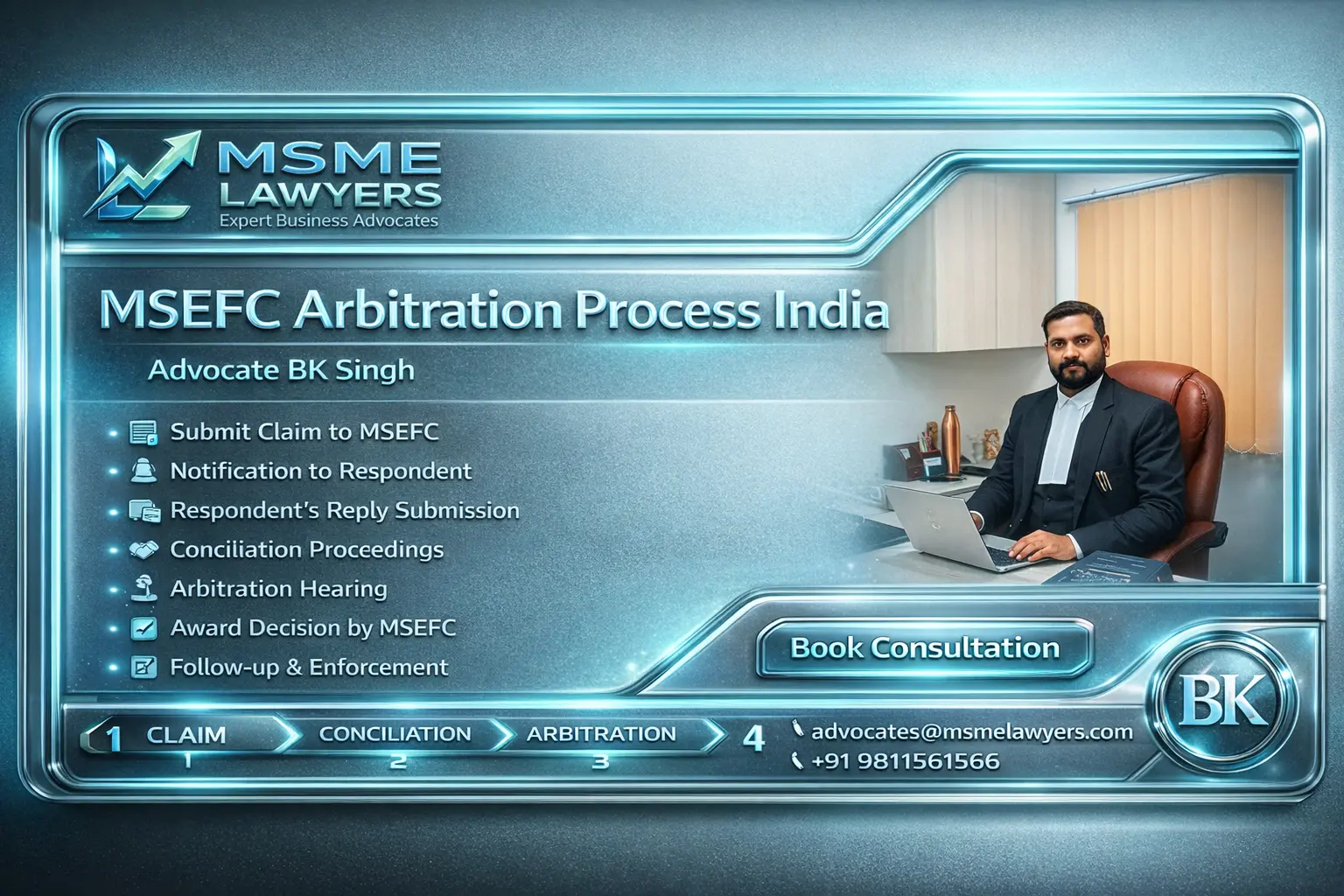
MSEFC Arbitration Process India
If a small business in India sells goods or services and the buyer keeps putting off payment, the problem isn't just money. It has an impact on salaries, payments to vendors, rent, GST compliance, and day-to-day survival. The Micro and Small Enterprises Facilitation Council, or MSEFC, can help micro and small businesses that are eligible and have problems with late payments. This is according to the MSMED Act of 2006. The law says that buyers must pay within the agreed-upon written time frame, which can't be longer than 45 days. If they don't, they may have to pay interest under Sections 15 to 17.
In real life, the MSEFC arbitration process in India gives real micro and small businesses a clear way to get their money back. It starts with conciliation and can go to arbitration if a settlement can't be reached. Section 18 says that MSEFC can handle disputes over amounts owed under Section 17. The Council can first try to settle the issue, and if that doesn't work, it can either arbitrate the issue itself or send it to an ADR institution. The Act also says that these kinds of references should be resolved within 90 days.
1. Why MSEFC is important for Indian businesses
One unpaid invoice can set off a chain reaction for many business owners, including small manufacturers, job workers, printers, transport contractors, fabricators, consultants, and local vendors. A buyer might keep saying that payment is still being approved, that accounts are checking, that the quality team hasn't cleared it, or that management will release the money next month. When the supplier finally realizes the delay is getting dangerous, working capital is already under a lot of stress. The MSEFC route is important because it gives eligible suppliers a legal way to get their money back, rather than just follow-up calls and emails.
This process is very helpful for small businesses and middle-class business owners who can't afford to keep going to court. At first, many clients don't want to fight in court. They want a clear legal path, pressure to pay, and the right paperwork. That is why MSME Lawyers and Advocate BK Singh often look at the history of invoices when goods or services were accepted, acknowledgment records, and the exact date when late payments and interest start to matter legally under the Act.
2. Who can use the msefc route?
The MSME Samadhaan portal says that any micro or small business with a valid Udyam Registration can apply. The portal's FAQ also says that Udyam Registration is required to get delayed payment benefits on the portal. The same FAQ also says that businesses must register before the date of the disputed invoice. This means that businesses usually can't take advantage of later registration for older invoices.
This is a very important practical point. Many small business owners only come to us for help after they have missed a payment, but the first legal question is whether the business was properly registered at the time. The claim gets stronger and clearer if the paperwork is in order. The strategy needs to be carefully changed if the registration timeline is weak. That's where MSME Lawyers and Advocate BK Singh come in. They can help business owners avoid filing a case that isn't strong enough and instead build the case on documents that meet the law and the portal's requirements.
3. The law says when payments are due and how much interest is charged.
According to Section 15 of the MSMED Act, the buyer must pay by the agreed-upon written date. In any case, the agreed-upon time cannot be longer than 45 days from the date of acceptance or deemed acceptance. Section 16 says that if the buyer doesn't pay as required, they will have to pay interest at three times the RBI bank rate that the Reserve Bank has set. The MSME Samadhaan site and FAQ also say that this interest is added to the principal every month.
Buyers take delayed payment cases under MSEFC very seriously once they know what the risk is. A disagreement that started with one unpaid bill can grow very quickly when statutory interest is added. This interest provision is not a technical luxury for a small supplier. It is often the difference between partial survival and total business strain. A proper calculation sheet made by MSME Lawyers and checked by Advocate BK Singh can also change the tone of the dispute from a casual delay to a legal responsibility.
4. Papers that usually determine how strong the case is
Usually, a strong MSEFC case is won on paper before it is argued in court. The Samadhaan FAQ says that a work order is required, and if the purchase order is verbal, an affidavit must be sent in to prove it. It also says that you can combine several invoices into one PDF and upload it. Businesses should also keep tax invoices, delivery receipts, email confirmations, ledger statements, transport records, proof of service completion, acknowledgment messages, and any history of part payments on hand.
In Indian business, buyers often don't deny the relationship. They put things off by making it hard to understand things like quality, internal approvals, reconciliation, debit notes, or waiting for signatures. That's why it's so important to put documents in the right order. MSME Lawyers and Advocate BK Singh usually tell their clients to put their records in order by date so the Council can quickly see supply, acceptance, follow-up, and non-payment. A well-organized file can put more pressure on you than any emotional claims ever could.
5. The MSEFC arbitration process in India step by step
The first step is usually to file a delayed payment application, which is often done through the MSME Samadhaan portal, which was made to make it easier to apply online. The FAQ makes it clear that the portal is not the only place where the claim idea came from; it is just a way to make things easier. After the claim is submitted, it is sent to the MSEFC that is in charge of it. The FAQ also says that the supplier does not have to send a legal notice before filing.
Section 18 says that once the reference is received, the Council may either handle conciliation itself or send the case to an ADR institution for conciliation. If conciliation fails and the case is still unresolved, the Council can either take up arbitration itself or send the case to arbitration. The Arbitration and Conciliation Act applies as if there were an arbitration agreement. The Act also says that the Council can act even if the buyer is in a different part of India as long as the supplier is in its jurisdiction.
Many states also require a signed and verified hard copy after filing, as the portal FAQ clearly states that this is necessary. Businesses should not think that just uploading something online is enough to get the job done. It matters that the rules are followed. So, a good filing strategy includes submitting through the portal, keeping track of acknowledgments, providing hard copies when necessary, and making sure that the claim set is properly indexed so that the Council can easily handle it.
6. What happens in conciliation and arbitration?
Conciliation is the first real chance to settle the issue without a full contested award. At this point, the Council or the institution that was referred to usually tries to find out if the buyer is willing to pay off the principal, interest, or both. A lot of buyers who didn't pay attention to informal reminders start to negotiate seriously when an official reference is on the way. The supplier should still be careful, though. A rushed settlement that doesn't include clear dates, consequences for default, and terms for withdrawal can lead to more problems. Section 18 intentionally sets up this staged process by putting conciliation before arbitration.
If conciliation doesn't work, arbitration happens next. The portal FAQ says that members who took part in conciliation can still take part in arbitration in this case. It also says that the process is a simple arbitration to make sure that Section 16 is followed. This is important because a lot of businesses think that if talks fail, they have to start over from scratch in a different place. The law says that the case can go on within the MSEFC framework.
7. Common disagreements and buyer complaints
A very common defense is that the goods were broken or the service wasn't good enough. The official FAQ says that breach of contract issues are not covered by the MSMED Act in the broad sense. It also says that rejecting goods should be real, happen within 15 days of receipt, and be reported to the supplier right away. This means that a buyer who stays quiet for a long time, uses the goods, and then makes vague complaints may have trouble explaining the delay.
When the same money claim is already in civil court, it becomes a problem in real life. The portal FAQ says that if you take the money to civil court, you can't take it to MSEFC. The FAQ also says that the Council does not deal with crimes. So the strategy for the forum is important from the start. MSME Lawyers and Advocate BK Singh usually look at whether the case should stay in the delayed payment framework, whether there is already another proceeding going on, and whether the business has done anything that could lead to a jurisdictional objection later.
8. Challenge the award and explain why legal strategy is important.
Section 19 of the MSMED Act gives suppliers a lot of protection. It says that a non-supplier appellant can't have their application to set aside an award or order heard unless they put 75% of the amount in court. The Samadhaan portal says the same thing and adds that courts may allow the supplier to get back a reasonable amount of the deposit during the challenge.
In many cases, this required deposit changes the balance of power in negotiations. It stops a buyer from casually challenging every bad order just to put off paying. That protection can be very important for small businesses. It also explains why a well-prepared claim is useful for more than just the first hearing. At MSME Lawyers, Advocate BK Singh usually looks at these cases from the point of view of business recovery. This means that the goal is not just to file a case, but also to make a record that makes settlement stronger, arbitration more likely to succeed, and post-award enforcement stronger.
Reviews From Clients
*****
Raghav Sethi
I was about to give up on getting my money back from the buyer because they kept coming up with new reasons to delay payment every week. MSME Lawyers explained the MSEFC process in a way that was easy to understand, and Advocate BK Singh helped us put all of our emails and invoices in order. The best part was the calm and honest advice. We finally saw movement where there had only been quiet before.
*****
Arora Nikita
Our small service business was having a hard time because a big client hadn't paid us in months. I was worried and unsure if MSEFC was the right way to go. MSME Lawyers made things very clear, and Advocate BK Singh made the process feel less scary and more doable. I felt like I had help at every step, which gave me the confidence to keep going.
*****
Sandeep Khurana
One late payment messed up our whole cash flow because I run a family business. We talked to a lot of people before this, but most of them gave vague answers. The advice at MSME Lawyers was clear, based on documents, and realistic. Advocate BK Singh never lied. He made the risks clear, and his honesty made me trust him.
*****
Pooja Malhotra
The buyer kept making new complaints after already using the services, even though our invoices were real. MSME Lawyers helped us make the record strong, and Advocate BK Singh gave us a good plan instead of letting our emotions get the best of us. It was a huge relief to finally know what to do and in what order to do it.
*****
Bansal Harish
As a small business owner, I needed legal help that understood more than just the law. MSME Lawyers did just that. Advocate BK Singh was helpful, practical, and focused on paperwork and what to do next. Once the legal process started, things became much more organized, which took a lot of stress off.
?FAQs
Q1. What is MSEFC arbitration in India?
Under the MSMED Act, MSEFC arbitration is a way for small and micro businesses that are having trouble getting paid on time by buyers to settle their disputes. Conciliation is usually the first step in the process, and if that doesn't work, arbitration can happen.
Q2. Who can bring a case to MSEFC?
According to the official portal, a micro or small business with a valid Udyam Registration can apply. Also, registering before the disputed invoice is important for getting benefits for delayed payment.
Q3. Is it necessary to give a legal notice before filing an MSEFC case?
No. The MSME Samadhaan FAQ says that the supplier does not need to send a legal notice to the buyer before going to the Council. Still, a lot of companies send one for the sake of keeping records and negotiating.
Q4. How long can a payment be made under the MSMED Act?
According to the law, the agreed-upon written credit period can't be longer than 45 days from when the goods or services are accepted or thought to be accepted. If you don't pay on time, you may have to pay statutory interest.
Q5. How do you figure out interest in MSEFC cases?
The official portal FAQ says that the calculation is done on a monthly compounding basis, and Section 16 says that the interest rate is three times the RBI bank rate.
Q6. What papers do you usually need to file with MSEFC?
The best cases usually have Udyam details, a work order or affidavit for an oral order, invoices, proof of delivery, a ledger, emails, and records of payment follow-ups. The FAQ for the portal talks about work order requirements and how to combine several invoices into one PDF.
Q7. Can a buyer from another state go to MSEFC?
Yes. Section 18 says that the Council can act even if the buyer is in a different part of India than the supplier.
Q8. How long does MSEFC take?
The Act says that every reference must be decided within 90 days of when it was made. In real life, timelines can change, but the law is clear that things should move more quickly.
Q9. Is it simple for the buyer to challenge an MSEFC award?
Not easily. Section 19 says that a non-supplier appellant must put down 75% of the award amount before the challenge can be heard. That rule often stops people from using casual delay tactics after the award.
Q10. Can MSEFC settle disagreements about quality and crimes?
The official FAQ states that the Council handles neither criminal offenses nor broad breach of contract issues through the delayed payment mechanism. It also says that refusing to accept goods should be real and done within 15 days.
There's no reason for concern. There is no difficult-to-understand legalese.
Someone who has helped many people with the same problems gives you clear, honest advice. We want to make the legal process easy to understand and use for everyone.