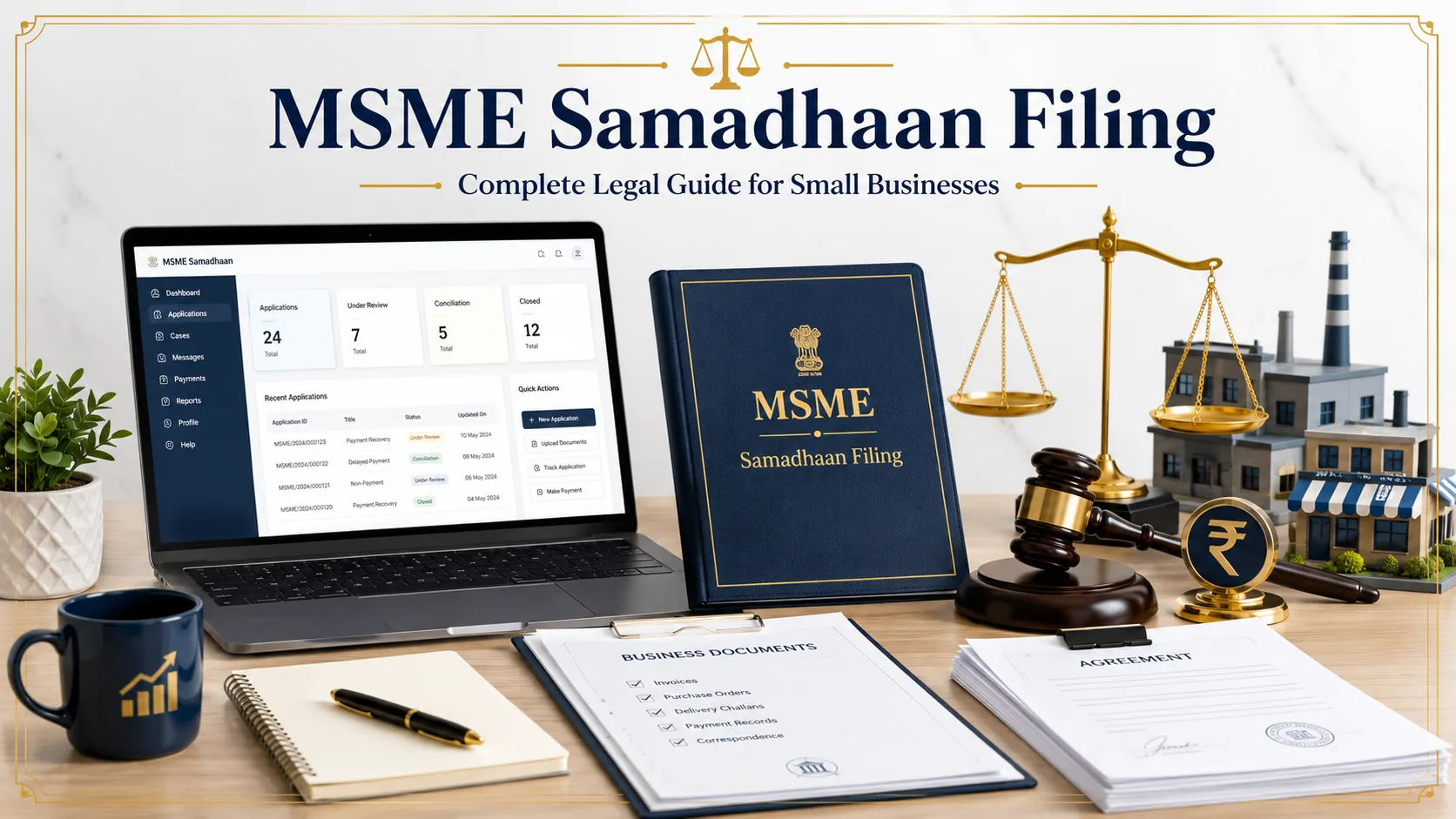
MSME Samadhaan Filing Guide A late payment does not seem threatening on day one. You are waiting for one invoice to be cleared. Next, another buyer sends a “just ten more days please” message. Due dates are coming close for salaries. GST, rent, vendors and EMI payments need to happen, but the receivable does not budge. It becomes more than an accounting issue for a micro or small supplier. It can disrupt the entire business cycle. MSME Samadhaan Filing lets eligible Micro and Small Enterprises access a statutory remedy for delayed payment claims before the concerned Micro and Small Enterprise Facilitation Council (MSEFC). MSEFCs are commonly known as MSME Facilitation Councils. This remedy is created under the MSME law called the Micro, Small and Medium Enterprises Development Act, 2006 which has specialDelayed payments to MSMEs have been on anyone who sells goods or services to big businesses. So delayed payments have legal importance under the MSME law. Small business owners in Delhi NCR, Noida, Ghaziabad, Gurugram, Faridabad, Meerut, Lucknow, Mumbai, Pune, Bengaluru, Hyderabad and Chennai delay taking action because they fear losing business. They send multiple WhatsApp messages. They accept excuses. They extend further credit. They keep supplying goods or services even when old bills have not been paid. That is the problem starting point. Filing a proper MSME Samadhaan complaint is more than uploading invoices on a portal. It requires a clear claim narrative. Supporting documents of supply, proof of acceptance, work order or purchase order, Udyam Registration certificate, invoice trail, payment reminders and legally structured representation. Even the official MSME Samadhaan FAQ states that suppliers can apply online and the concerned MSEFC takes action on such filings. In this guide for small businesses, you will learn about the MSME Samadhaan process, key documents, legal framework, typical timelines, mistakes to avoid and how a lawyer can help prepare a stronger MSME payment recovery claim. A late payment hurts smaller companies more because they don’t have infinite working capital. A large buyer can extend payments to 90 or 120 days and keep the business rolling. A small supplier may find it tough to cope after even one unpaid bill. In 2026, MSME invoice recovery has a greater sense of urgency because sellers operate in multiple cities, online marketplaces, vendor ecosystems, government tenders and large corporate supply chains. A supplier in Ghaziabad may sell goods to a buyer in Gurugram. An IT services provider in Noida may work for a Mumbai firm. A Delhi consultant may invoice payments to a Bengaluru startup. The case may seem local, but the actual buyer could be anywhere in India. Section 15 of MSMED Act provides for an important detail about compensation date. The compensation or payment is due 30 days from the date of furnishing of the goods/services as stated in the application. The MSMED Act tries to solve this practical problem by giving Micro and Small Enterprises a separate statutory remedy for late payments. The MSME Samadhaan website further clarifies that provisions relating to delayed payment have been contained in Sections 15 to 24 of the MSMED Act and State Governments are mandated to establish MSEFCs for redressal of such disputes. If your MSME is in Delhi NCR, evidence from the local city often becomes critical. Challans, emails, GST invoices, ledger statements, e-way bills, purchase orders, service completion acknowledgements and proof of part-payment help establish that the buyer received the work or goods but refused to pay. Supplier should not treat delayed payment as a routine follow-up item indefinitely. The invoice problem should be addressed legally once late payments start affecting salaries, fresh stock purchase, credit lines or taxes. Small businesses can read about Legal Advice for MSME Recovery if they want focused guidance on unpaid invoices before deciding on their next step. MSME Samadhaan is primarily a delayed payment application route for eligible Micro and Small Enterprises. Every buyer must adhere to the agreed payment period. Agreed payment cannot exceed 45 days as per Section 15 of the MSMED Act. Buyers can be asked to pay interest for delayed payments. Interest for delayed payment is at three times the RBI notified bank rate compounded monthly as per Section 16. Each MSEFC handles its own MSME Samadhaan cases after online applications are sent to them. As of Oct 2022, new delayed payment applications are being sent to MSME ODR Portal Business owners do not need to send a legal notice before MSEFC filing. A legal notice can work in some cases, but the official MSME Samadhaan FAQ says it is not required to be sent before filing before the Council. Sometimes, a well-structured set of documents works better than emotional reminders. MSME Samadhaan Filing refers to the process of online application filing for delayed payments. Eligible Micro and Small Enterprises can raise delayed payment applications from buyers for recovery of due money. The concerned MSEFC handles the matter thereafter. Please note – MSEFCs examine claims, try to settle disputes and initiate adjudication proceedings if necessary. Their role is not just an online portal for applications. The MSME Samadhaan website describes it as follows: Further, it adds: To simplify, MSME Samadhaan allows a supplier to say: “I supplied goods or services, the buyer accepted them against a promise to pay, payment is overdue, and now I am invoking my legal remedy.” This is separate from normal civil recovery process. You can still file a civil suit or commercial suit in many cases, but the MSMED Act provides a separate process just for Micro and Small Enterprises. That process also includes interest and MSEFC pressure, which can encourage a defaulting buyer to pay. The main law is the Micro, Small and Medium Enterprises Development Act, 2006. Chapter V talks about delayed payments to MSMEs. Briefly, these are the key points under this Chapter: The critical point is that MSMED Act allows MSEFCs to help Micro and Small Enterprises resolve delayed payment cases. As mentioned on the MSME Samadhaan portal: A supplier should read this guide when the buyer has accepted the goods or services but not paid on time. This can apply to manufacturers, service companies, job workers, consultants, technology businesses, suppliers of goods, vendors, B2B companies selling to large businesses, businesses selling to government departments, etc. Small businesses usually contact a lawyer only when the buyer refuses to respond. That is too late in most cases. Early preparation helps. If the buyer has started saying your invoice has errors again and again, denying quality after months of usage, withholding TDS certificates, stopping payment without notice or asking for more work on loan, it’s time to get the file checked. Supplier clients come from Delhi NCR, Ghaziabad small scale industry, Noida, Greater Noida and Gurugram very often. If you search for MSME Lawyers in Delhi and pick the city you operate in, most local business owners would need help with both filing the application and representing their case at MSEFC. It’s not enough to just file on the portal. Buyer-side businesses may need this guidance too. Sometimes a buyer gets a notice for something they didn’t accept, or where supply was a condition precedent, or where service quality was actually rejected, or the invoice was inflated. MSEFC cases require a proper response, not an email saying you deny the whole claim. STEP 1: Establish eligibility to apply. Have you Udyam registered? As the official MSME Samadhaan FAQ states: STEP 2: Check documents. What is your evidence of supply? Do you have the purchase order or work order? Tax invoices? Proof of delivery? GST entry? Service completion notes? Acknowledgements from the buyer? Email trail? Ledger statement from your accounts team? Payment reminders sent? Record of part-payment received? These are important pieces of evidence you must gather before filing. STEP 3: Calculate the amount fairly. How much is due? What is the principal amount? Show invoice-wise dates, dues dates and part-payments if any. Calculate interest properly. Don’t mix things up. A messy calculation can reduce a legitimate claim. STEP 4: File the application via the appropriate online channel. Delayed payment applications are now being sent to MSME ODR Portal. Check the latest route to file MSME Samadhaan Application before applying. You can still read useful public information, FAQs and MSEFC details on the older Samadhaan Portal, but filing is being directed to the MSME ODR site. STEP 5: Application will be sent to the concerned MSEFC. The MSEFC may examine your application, ask questions, try to settle and then follow up with MSEFC adjudication if conciliation fails. The website states under ‘Timings for action’: But in practice, this timeline varies because of pending applications, buyer objections, incomplete applications or MSEFC workload. Documents can make or break an MSME Samadhaan application. A genuine but incomplete invoice can lead to the buyer saying that goods were never dispatched, services were not started or not agreed to in the first place. The official MSME Samadhaan FAQ states: It also says: Apart from these documents mentioned on the website, every case has its own facts. Here is a practical document checklist for most applications: The legal notice is not compulsory before MSEFC filing. You don’t have to send one. But from experience, a legal notice works in many cases to establish that the buyer was given one last opportunity to pay and to put your claim story in order. If your business has several invoices pending from the same buyer, you may also want to read about MSME Delayed Payment Recovery. Did the buyer promise to pay in 30 days? 45 days? 60 days? The MSMED Act applies where the agreed payment terms are not more than 45 days from the date of acceptance or deemed acceptance. If the agreement says 30 days, payment should be made within 30 days. Simple. If there is no written payment period, the law refers to the appointed day. Many small business owners do not realise this and believe that the buyer can decide the payment date at their convenience later. That is not correct. Refer to Section 15 of MSMED Act for details. Application reviewing and MSEFC hearing delays are possible if your application is incomplete, documents are unclear, wrong jurisdiction is chosen, the buyer says quality was not given, or the MSEFC wants further clarification. See this MSEFC listing to understand where to file based on your city or buyer location. MSME Samadhaan refers to the delayed payment application process for MSME suppliers. Eligible Micro and Small Enterprises can apply online for their unpaid dues. The concerned MSEFC takes it up further. Any Micro or Small Enterprise can file a MSME Samadhaan application. Ensure your Udyam Registration is active and you meet eligibility criteria. As per the official MSME Samadhaan website: Yes. The Udyam Registration is mandatory. Check the official MSME Samadhaan FAQ: It also adds: That means your MSME registration must exist before the invoice raised. You cannot get backdated Udyam Registration for old invoices. Medium Enterprises are outside the scope of MSMED Act protections unless they are classified down at the time of dispute. Please consult a lawyer if your enterprise was recently upgraded to medium classification. No. As per the official MSME Samadhaan FAQ page: MSEFC applications require proof of commercial transaction. See the official MSME Samadhaan FAQ: Basically, you can submit secondary evidence like emails, WhatsApp chats, GST invoices, acknowledgment receipts or any written proof you have. The buyer gave part-payment as well? Include that bank entry screenshot too. As per Section 16 of MSMED Act, the interest is recoverable as follows: Delayed payment interest = Principal due x3 X RBI Bank Rate%. Interest is compounded monthly with a monthly rest. Yes. MSEFCs are present in every State. The buyer could be located in Delhi and you in Mumbai. File the application where your supplier business is registered or where the actual cause of action (dispute) has arisen. Your MSME Samadhaan application will be sent to the concerned MSEFC. They will examine your claim, ask questions, hear both sides and follow up as per MSMED Act procedures. This includes MSEFC conciliation efforts and MSEFC hearings if conciliation fails. Hiring a lawyer depends on the facts of your claim. If the amount is large enough, documents are in order, and you have a clear reason to recover the payment, it helps to have legal advice. Lawyers can help with MSEFC claim preparation, legal notice drafting, vendor objections and MSEFC hearings. Advocate BK Singh focuses on MSEFC claims and representing MSME suppliers in Delhi NCR. His goal is to keep hassles minimal for small businesses facing genuine payment difficulties. He has helped multiple MSMEs understand their legal rights, organise claim paperwork and take measured action against overdue buyers. Learn more about BK Singh’s approach to MSME and supplier claims here and schedule a call to discuss your situation. You can also browse MSME Lawyers who assist businesses with payment recovery across multiple Indian cities. Delayed payments can hurt more than you think at first. Don’t let unpaid invoices pile up. While many suppliers rush to MSEFC filing, a better approach is to assess documents, calculate amounts properly and send a legal notice to at least try one last chance. Does that mean panicking and sending a legal notice as soon as payment is late? Absolutely not. But when invoices remain unpaid beyond the agreed terms and payment requests are being ignored, the receivable file needs to be examined by someone who knows MSME law. Learn more about fighting delayed payments with MSME Lawyers and Advocate BK Singh. Clients appreciate his focus on legal documentation and building a strong payment recovery case. Image Credit : Farid Sheeran on Unsplash Disclaimer: This article is intended for general informational purposes only. It is not legal advice or a substitute for legal advice. For advice tailored to your specific facts and circumstances, please contact Adv. BK Singh or another lawyer.MSME Samadhaan Filing Explained: Complete Legal Guide for Businesses in India
Delhi NCR MSME Lawyers: Unpaid Invoices Tips by Advocate BK Singh
Why This Issue Impacts Small Businesses Across India & Delhi NCR in 2026
Quick Facts Box
What Exactly is MSME Samadhaan Filing?
“The MSME Samadhaan Portal is a delayed payment grievance redressal system available to Micro and Small Enterprises as provided under the MSMED Act.”
“Any Micro or Small enterprise having valid Udyam Registration can apply.”
Legal Framework for MSME Samadhaan Application
“Provisions relating to delayed payment have been contained in Sections 15 to 24 of the MSMED Act and State Governments are mandated to establish Micro and Small Enterprise Facilitation Councils for redressal of such disputes.”
Who Should Read This Guide?
Step-by-Step Guide to MSME Samadhaan Application Process
“Udyam Registration is mandatory for availing benefits under the delayed payment provisions of MSMED Act, 2006 and prior registration of the enterprise before the date of disputed invoice is mandatory as benefits under MSMED Act, 2006 cannot be claimed retrospectively”
“The references are required to be decided within ninety days from the date of receipt of such reference, as the case may be”
Documents Required for MSME Samadhaan Delayed Payment Application
“A work order is compulsorily required. In case the purchase order is oral, an affidavit to that effect has to be submitted.”
“Acknowledgements on invoice, delivery challans, part payment made and emails would be accepted as secondary and corroborative evidence.”
Document Reason to have it Udyam Registration certificate Under MSMED Act, you must be classified as an MSME first Purchase order or work order Show you were given order by the buyer and on what terms Tax invoices Help establish amount billed and dates Delivery challans/service completion proof Help prove goods were supplied or work was performed Emails/Whatsapp messages/acknowledgements Help establish acceptance, payment reminders and buyer behaviour Ledger statement Pops up the outstanding amount and part payments if any Bank statement (entries) Corroborate part payment evidence if any GST returns/e-way bills/transport records If goods were supplied to the buyer, maintain GST proof, e-way bills etc. Legal notice If you sent one, try to establish a last chance given to buyer to pay Buyer reply to any notice you may have sent (if any) Timelines: Understanding Practical Delays and Decision Windows
Frequently Asked Questions About MSME Samadhaan Application
1. What is MSME Samadhaan?
2. Who can file MSME Samadhaan application?
“Any Micro or Small enterprise having valid Udyam Registration can apply.”
3. Do I need Udyam Registration for MSME Samadhaan?
“Udyam Registration is mandatory for availing benefits under the delayed payment provisions of MSMED Act, 2006”
“prior registration of the enterprise before the date of disputed invoice is mandatory”
4. Can a medium enterprise file under MSME Samadhaan?
5. Is it mandatory to send a legal notice before applying?
“It is not necessary to send a legal notice before filing before the Council. However, in many cases, it helps in recording the demand, giving the buyer one last chance to pay and organising your claim.”
6. What if I do not have a written purchase order from the buyer?
“A work order is compulsorily required. In case the purchase order is oral, an affidavit to that effect has to be submitted”
7. How much interest can I claim from buyer?
8. Can I use MSME Samadhaan if the buyer is in a different State?
9. What happens after I apply?
10. Should I hire a lawyer for MSME Samadhaan?
Expert MSME Lawyers for Guide Readers
Final Advice on MSME Samadhaan Filing
Disclaimer
Table of Contents
There's no reason for concern. There is no difficult-to-understand legalese.
Someone who has helped many people with the same problems gives you clear, honest advice. We want to make the legal process easy to understand and use for everyone.