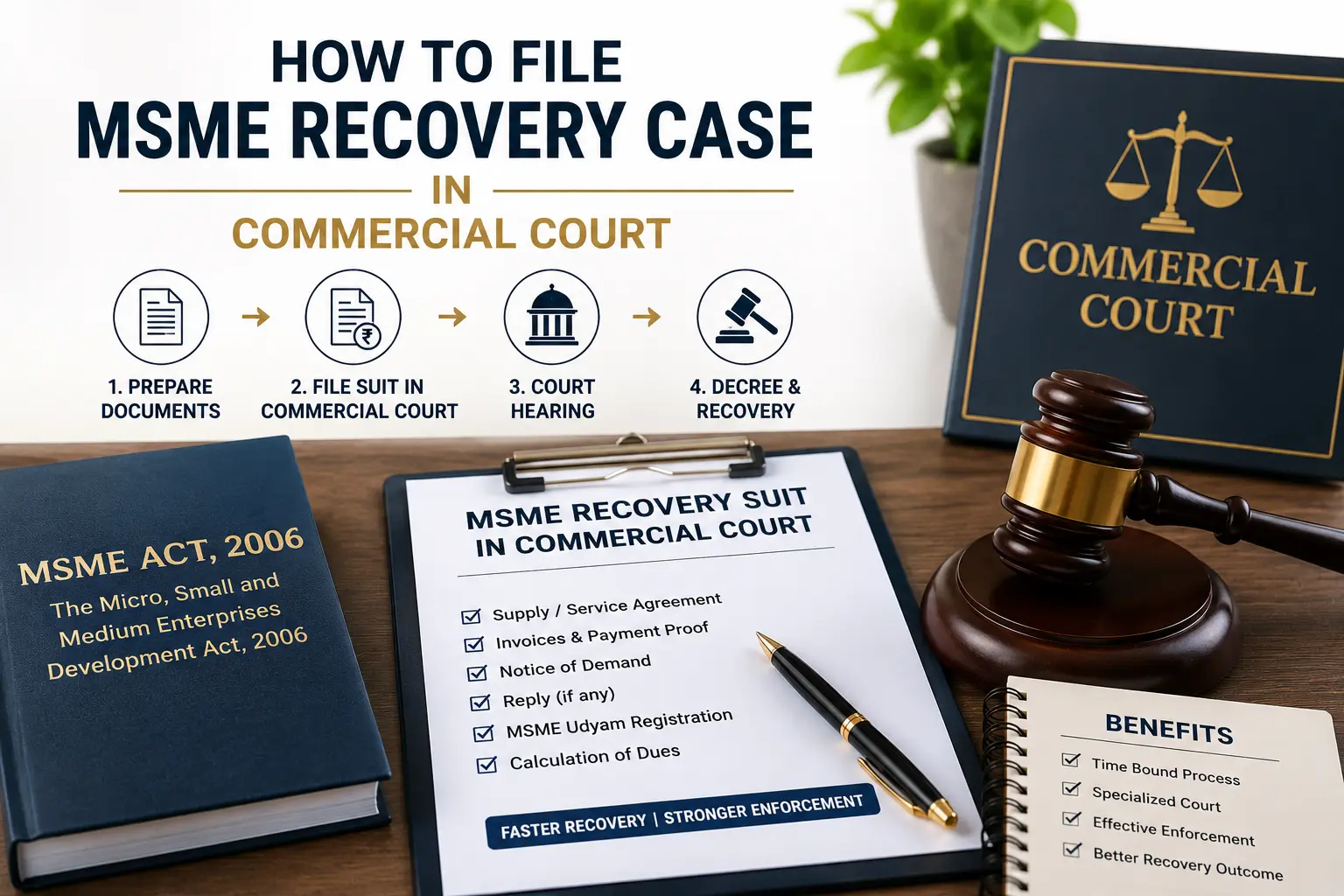
A delayed business payment can disturb an entire MSME. One unpaid invoice may stop salaries, delay GST filings, affect vendor relations, and create pressure from banks. For many small business owners, the question is not only “Will the buyer pay?” but “What legal step should I take now?” How to File MSME Recovery Case in Commercial Court is a serious question because Commercial Court filing is not the same as sending a normal legal notice or casually filing a civil recovery suit. The claim must qualify as a commercial dispute. The value, documents, jurisdiction, pre-institution mediation, court fees, pleadings, and evidence must be checked before filing. A commercial recovery suit can be useful when the dispute arises from invoices, supply of goods, service contracts, purchase orders, work orders, distributorship arrangements, consultancy work, construction-related supply, agency transactions, or other business dealings. The Commercial Courts Act, 2015 was enacted for adjudication of commercial disputes of specified value through Commercial Courts, Commercial Divisions and Commercial Appellate Divisions. Many MSME owners in Delhi NCR, Ghaziabad, Noida, Gurugram, Faridabad, Meerut, Lucknow, Jaipur, Mumbai, Pune, Bengaluru, Hyderabad, Chennai, Kolkata, Ahmedabad and other business centres face the same pattern. Goods are supplied. Bills are raised. Emails are exchanged. Then the buyer says “next week,” “management approval pending,” or “quality issue.” Months pass. Advocate BK Singh often advises business owners to decide early whether the matter needs a legal notice, MSME Samadhaan filing, Commercial Court suit, arbitration, settlement discussion, or execution proceedings. A wrong first step can waste time. A carefully prepared case can put pressure where informal follow-up has failed. MSME payment disputes are not small paperwork problems. They affect survival. A Delhi-based trader may have supplied material to a contractor. A Noida manufacturer may have delivered parts to a large company. A Ghaziabad service provider may have completed a digital, security, staffing, packaging or fabrication contract. If payment gets stuck, the MSME still has rent, wages, GST, vendor credit and loan EMIs to manage. Commercial Courts matter because they bring business disputes into a more structured process than ordinary informal recovery attempts. The Commercial Courts Act contains a defined framework for commercial disputes, specified value, pre-institution mediation, appeals, transfer of pending cases, and CPC amendments for commercial matters. For MSMEs, the practical issue is choice of route. A micro or small enterprise with valid Udyam Registration may also consider the MSME Samadhaan route before the Micro and Small Enterprise Facilitation Council. The official MSME Samadhaan portal states that any micro or small enterprise with valid Udyam Registration can apply, and that delayed payment cases are handled through MSEFC under the MSMED Act, 2006. Commercial Court filing becomes relevant when the business wants a civil commercial recovery suit, when the dispute fits the Commercial Courts Act, when urgent interim relief may be needed, when the contractual structure makes a court suit more suitable, or when the matter involves enforcement after arbitration or MSEFC proceedings. Delhi NCR has a high concentration of suppliers, distributors, manufacturers, contractors and service companies. New Delhi, Ghaziabad, Noida, Greater Noida, Gurugram and Faridabad see regular disputes involving unpaid invoices, defective payment promises, post-dated cheques, delayed purchase order payments and corporate buyer defaults. A properly drafted Commercial Court case can protect limitation, preserve documentary evidence, and show the buyer that the supplier is no longer waiting casually. A MSME recovery case in Commercial Court is a legal action filed to recover unpaid business dues arising from a commercial transaction. In simple terms, it is a court case where the supplier asks the Commercial Court to pass a decree for principal amount, interest, costs and other lawful reliefs. Not every money claim becomes a commercial dispute. A friendly loan, family transaction or casual cash arrangement may not fit the Commercial Courts Act merely because money is unpaid. The dispute must arise from business dealings such as sale of goods, provision of services, mercantile documents, trade contracts, commercial agreements or similar recognised commercial transactions. The core distinction is this: MSME Samadhaan is a statutory delayed payment route for eligible micro and small enterprises under the MSMED Act, while Commercial Court is a civil court route for commercial disputes of specified value. Sometimes both routes must be compared before choosing. Sometimes one route is stronger. Sometimes the contract contains arbitration, and that changes the filing strategy. Advocate BK Singh usually examines four basic questions before suggesting Commercial Court filing. First, who supplied what? Second, what written document proves the buyer’s obligation? Third, where did the transaction or breach take place? Fourth, is there any arbitration clause, jurisdiction clause, or prior MSEFC filing? A good recovery case is not built only on anger. Courts decide documents, pleadings and evidence. A business owner may feel cheated, but the plaint must show contract, supply, acceptance, default, liability, territorial jurisdiction, limitation and relief. The legal framework for a MSME recovery case in Commercial Court usually involves the Commercial Courts Act, 2015, the Code of Civil Procedure, 1908 as amended for commercial disputes, the Indian Contract Act, 1872, the Limitation Act, 1963, the Evidence Act framework now read with current evidence law where applicable, and sometimes the MSMED Act, 2006. The Commercial Courts Act creates special courts and divisions for commercial disputes. India Code lists provisions dealing with jurisdiction of Commercial Courts, Commercial Divisions of High Courts, arbitration matters, specified value, pre-institution mediation, appeals, transfer of pending cases and CPC amendments for commercial disputes. A payment recovery matter may qualify as a commercial dispute when it arises from ordinary transactions of merchants, traders, financiers, bankers, agreements for sale of goods, provision of services, agency contracts, distribution agreements, construction contracts, consultancy agreements or similar business arrangements. A plain loan between two individuals may not automatically qualify. For MSMEs, invoices, purchase orders, work orders, email approvals, tax invoices, e-way bills, delivery challans, ledger confirmations and balance confirmations often become the backbone of the case. A Commercial Court will check whether the claim meets the specified value requirement. In a money recovery case, the amount claimed, including interest computed up to the filing date where legally claimed, may become relevant for valuation. Section 12 of the Commercial Courts Act deals with determination of specified value. Court fees also matter. The plaintiff cannot casually inflate or undervalue the claim. State court-fee rules and local practice should be checked before filing. Section 12A of the Commercial Courts Act deals with pre-institution mediation and settlement. In broad terms, where a commercial suit does not seek urgent interim relief, pre-institution mediation may become a mandatory procedural step before filing. This is where many MSME recovery cases get delayed. A business owner prepares a plaint, reaches court, and then learns that the case may need pre-institution mediation first. If urgent interim relief is genuinely required, such as protection against asset dissipation in a suitable case, the pleading must be carefully framed. Courts do not appreciate artificial urgency. Sections 15 to 24 of the MSMED Act deal with delayed payment to micro and small enterprises, and the MSME Samadhaan portal confirms that MSEFC handles delayed payment references under that framework. Where the supplier is eligible, the MSMED Act route may provide statutory interest and MSEFC proceedings. Yet Commercial Court may still matter for certain commercial suits, arbitration-related applications, enforcement, execution, contractual disputes outside the MSEFC route, or cases where the business chooses a civil commercial remedy after legal assessment. A smart legal strategy does not blindly file everywhere. It chooses the correct forum. This guidance is useful for manufacturers, traders, service providers, consultants, contractors, distributors, wholesalers, fabricators, IT vendors, staffing agencies, packaging suppliers, logistics companies, advertising agencies, repair vendors, engineering units and other MSMEs that have supplied goods or services but have not received payment. A small company in Okhla may face non-payment from a buyer in Gurugram. A Greater Noida unit may have supplied material to a real estate contractor. A Meerut manufacturer may have invoices pending from a Delhi distributor. A Pune service firm may have completed work for a Mumbai corporate buyer but received only part payment. Students or general readers may read this topic for awareness, but the people most affected are business owners who have already sent reminders and now need a legal path. For Delhi and NCR-based businesses, the MSME Lawyers India website can be used as a starting point for MSME recovery, dispute and legal service information. Advocate BK Singh also sees many cases where the owner delays action because the buyer is “known,” “old client,” or “promising payment after bank clearance.” Commercial recovery law rewards documents and timely action. Verbal assurances rarely protect limitation. This guidance is also useful for accountants, company directors, startup founders and family-run business owners. Many of them handle recovery casually until the amount becomes too large to ignore. The process begins before the case reaches court. A well-prepared MSME recovery case is built like a file, not like a complaint written in frustration. The business must collect documents, calculate dues, identify the correct defendant, examine jurisdiction, issue a legal notice where suitable, complete pre-institution mediation if required, and then file a proper commercial plaint. Start with the transaction. Was there a purchase order? Was the work done under email confirmation? Did the buyer sign a contract? Did the buyer accept invoices without objection? Did the buyer make part payment? Did the buyer deduct TDS? Did the buyer confirm balance by email or WhatsApp? These facts show liability. A vague claim saying “they owe us money” is weak. A clear claim saying “goods were supplied under purchase order dated X, tax invoice Y was raised, delivery was accepted, part payment was made, and balance remains unpaid” is much stronger. The dispute should arise from a commercial transaction. Sale of goods, supply contracts, service agreements, consultancy work, distribution arrangements, agency contracts and business-to-business invoices generally have a stronger commercial character. If the transaction is mixed or unusual, a lawyer should examine whether Commercial Court jurisdiction applies. Filing in the wrong forum can lead to objections, return of plaint, delay and extra cost. Jurisdiction usually depends on defendant location, place of contract, place of supply, place of payment, cause of action and contractual jurisdiction clause. If a purchase order says courts at Delhi alone shall have jurisdiction, that clause must be studied. If the buyer is in Noida and goods were supplied from Ghaziabad, the jurisdiction analysis may differ from a case where the invoice and agreement clearly point to Delhi. For local assistance, businesses around Ghaziabad can review MSME Lawyers in Ghaziabad for city-specific MSME dispute support. Many contracts contain arbitration clauses. Some purchase orders contain unilateral dispute clauses. Some service agreements specify venue, governing law and notice procedure. These clauses may change the recovery route. If the supplier is a micro or small enterprise with valid Udyam Registration, the MSMED Act and MSEFC route should also be examined. A business should not ignore statutory delayed payment rights merely because a buyer has inserted a one-sided clause. A legal notice is not always mandatory for every commercial recovery suit, but it often helps. It gives a final opportunity to pay, creates a formal record, clarifies the amount due, responds to fake quality objections, and shows the court that the plaintiff acted reasonably. The notice should mention invoices, purchase orders, delivery proof, outstanding principal, interest basis, reminders and payment deadline. It should not contain wild allegations that cannot be proved. Advocate BK Singh generally prefers notices that are firm but commercially sensible. A notice should create pressure without damaging settlement chances. If the suit does not seek urgent interim relief, Section 12A pre-institution mediation may need to be completed before filing. The plaintiff usually approaches the appropriate legal services authority for mediation as per applicable rules and local practice. If mediation succeeds, settlement can save cost and time. If it fails or the defendant avoids participation, the plaintiff gets a record that can support filing. The plaint should contain clear facts, jurisdiction, cause of action, limitation, valuation, court fees, reliefs, interest claim and document references. Commercial suits also require disciplined document filing, statements of truth, affidavits, proper indexing and compliance with court procedure. A weak plaint creates openings for the defendant. A strong plaint narrows the dispute. For businesses comparing court remedies, Commercial Court Case Lawyer is a relevant same-domain resource for commercial disputes, contract claims and payment recovery support. After filing, the court registry scrutinises the plaint. Defects may need correction. Once the matter is registered, summons are issued to the defendant. The defendant may file a written statement, raise jurisdiction objections, deny liability, allege quality defects, or claim set-off. Commercial suits follow stricter timelines and document rules than ordinary casual litigation. The plaintiff must stay alert. Commercial Court procedure gives importance to documents. Parties may be required to admit or deny documents. Courts may frame issues, fix timelines, control evidence and move the matter through case management. Where the defence is weak and documents are clear, summary judgment may be considered in suitable cases under the commercial suit framework. But that depends on facts, pleadings and court discretion. Winning a decree is not the last step. If the buyer still does not pay, execution may be required. Attachment of bank accounts, assets, receivables or other lawful execution steps may be considered as per law. A recovery case should be prepared with execution in mind from day one. Know the buyer, its address, bank details where lawful, assets, business locations and directors or partners where relevant. Documents decide commercial recovery cases. Oral explanations help the lawyer understand the story, but courts need proof. A practical checklist includes: MSME recovery cases often fail at the evidence stage because businesses do not keep proper delivery proof. An invoice alone may not always be enough if the buyer denies supply. Delivery and acceptance matter. For Delhi-based payment disputes, MSME Payment Recovery Lawyer in Delhi is a relevant internal resource on unpaid invoices, delayed payments and recovery support. Limitation is usually a major concern in recovery cases. Many money claims are time-sensitive, and the limitation period often depends on the nature of transaction, date of invoice, date of payment due, date of part payment, written acknowledgment, balance confirmation and other facts. The exact limitation calculation should be checked before filing. Pre-institution mediation may add time, but skipping it where required can damage the case. If urgent interim relief is genuinely needed, the plaint must explain urgency clearly. Courts can reject artificial urgency. Commercial Court timelines also depend on registry scrutiny, service of summons, defendant response, admission-denial of documents, interim applications, evidence, court workload and settlement talks. A case with clear invoices and admitted liability may move differently from a case involving quality disputes, counterclaims or complex accounting. The business should take a decision early when any of these windows appear: A director or proprietor should not wait until the buyer becomes untraceable. Litigation works best when the defendant still has a functioning business, identifiable address and recoverable assets. The first mistake is filing without checking whether the matter is fit for Commercial Court. Every unpaid amount is not automatically a commercial suit. The second mistake is ignoring the MSMED Act route where the supplier is eligible. Micro and small enterprises with valid Udyam Registration should compare MSEFC and Commercial Court options before choosing. Many businesses send angry WhatsApp threats instead of a proper legal notice. Those messages later become embarrassing exhibits. Some suppliers keep raising fresh invoices or revised ledgers without reconciling accounts. That gives the buyer an excuse to dispute the amount. A common mistake is suing the wrong party. The purchase order may be issued by one company, payment may come from another, and emails may be sent by a group employee. Defendant identification needs care. Another error is forgetting pre-institution mediation. In suitable cases, Section 12A compliance can become a threshold issue. Many MSMEs do not preserve proof of delivery. Transport slips, e-way bills, gate entry records and signed challans should be saved. Some owners wait for years because the buyer is a large company. Polite follow-up is fine for a short period. Endless waiting is not strategy. A few plaintiffs claim excessive interest without contractual or statutory basis. Interest must be pleaded properly. The last mistake is treating filing as the end. Recovery needs follow-up, evidence management, settlement evaluation and execution planning. Advocate BK Singh often tells clients that recovery law is part legal, part documentation, and part commercial judgment. All three must work together. Ignoring an unpaid commercial debt can create legal and business damage. The most obvious risk is limitation. If the claim becomes time-barred, even a genuine unpaid invoice can become hard to recover through court. Cash-flow damage comes next. MSMEs run on rotation. One delayed buyer can create pressure from suppliers, banks, employees and tax departments. Documentation also weakens with time. Employees leave. Email threads get deleted. Courier records disappear. Delivery acknowledgments become harder to trace. The buyer may later deny supply or claim defects. Delay can also affect negotiation strength. A buyer who sees that the supplier is only sending reminders may continue delaying. A formal notice, mediation record or court filing changes the tone. For companies, unpaid dues also affect books, audit, GST reconciliation, tax treatment and provisioning. A proper legal action may help show that the business actively pursued recovery. Reputation risk is real too. Small suppliers sometimes keep quiet because they fear losing future business. That fear may be understandable, but a defaulting buyer often repeats the same behaviour with vendors who do not act. Consult a lawyer when the buyer crosses the agreed payment period and stops giving clear timelines. Consult earlier if the amount is large, the buyer is denying liability, or the contract contains arbitration or jurisdiction clauses. Legal consultation becomes urgent if limitation is approaching, the buyer has shifted office, the company is under financial stress, insolvency rumours are circulating, or the buyer has started making false quality allegations. A lawyer should also review the file before pre-institution mediation. A poorly prepared mediation statement may weaken later court pleadings. Advocate BK Singh can examine whether the matter should go to Commercial Court, MSME Samadhaan, arbitration, legal notice route, settlement negotiation, or another lawful remedy. The right answer varies case to case. Small businesses should not assume that legal advice means immediate litigation. Sometimes the best first step is a strong notice. Sometimes a mediation attempt works. Sometimes court filing is necessary because the buyer has already crossed every reasonable opportunity. MSMELawyers.com focuses on MSME recovery, business payment disputes, commercial litigation, legal notices, MSEFC-related guidance and court-based recovery support. The role is not to promise guaranteed recovery. The role is to prepare the matter properly, choose the correct legal route, and present the claim with documents. Advocate BK Singh can assist with reviewing invoices, drafting legal notices, calculating outstanding amounts, checking Commercial Court jurisdiction, preparing pre-institution mediation papers, drafting plaints, filing commercial recovery suits, responding to buyer objections, and planning execution after decree. The team can also help decide whether MSME Samadhaan, Commercial Court, arbitration or settlement discussion is more suitable. For wider reading, the MSME Legal Blogs section contains business law and MSME dispute information. Business owners often reach out after months of follow-up. A better approach is to get the file reviewed once the payment delay becomes serious. Early review does not always mean filing the next day. It means knowing your position before the buyer controls the narrative. To file a MSME recovery case in Commercial Court, first verify that the dispute is commercial, the claim meets specified value requirements, the correct court has jurisdiction, and documents support the claim. Then issue notice where suitable, complete pre-institution mediation if required, prepare a commercial plaint, pay court fees and file through proper procedure. Every MSME cannot file automatically merely because it is MSME. The claim must qualify as a commercial dispute of specified value. The business must also prove cause of action, jurisdiction, limitation and liability. Advocate BK Singh can review the file and suggest whether Commercial Court is the correct route. It depends on the facts. MSME Samadhaan may help eligible micro and small enterprises under the MSMED Act. Commercial Court may suit contractual recovery, urgent civil relief, commercial suits, arbitration-related issues or enforcement steps. A lawyer should compare both before filing. The Commercial Courts Act works with the concept of specified value. The threshold is not less than Rs. 3,00,000 (Rupees Three Lakh Only), subject to applicable provisions and local setup. Exact valuation should include proper calculation of principal, interest and relief. For commercial suits that do not seek urgent interim relief, Section 12A pre-institution mediation may apply. If urgent interim relief is genuinely required, the pleadings must explain it properly. Skipping mediation without legal assessment can create filing objections. Yes, interest may be claimed if supported by contract, invoice terms, trade practice, statute or equitable grounds. For eligible micro and small enterprises under the MSMED Act, delayed payment interest principles may apply. The calculation must be pleaded carefully. The supplier must rely on delivery proof, acceptance records, emails, inspection notes, absence of timely rejection, part payment, use of goods and other evidence. Late quality objections are common in recovery disputes. Documents decide whether the defence has substance. Advocate BK Singh can guide MSME recovery strategy for India, Delhi NCR, Delhi, New Delhi, Ghaziabad, Noida, Greater Noida, Gurugram, Faridabad and other major business locations. Court filing and appearance depend on forum, jurisdiction and local procedural requirements. Timelines vary case to case. Factors include service of summons, defendant objections, document admission-denial, interim applications, mediation history, court workload and evidence. A well-documented claim usually moves better than a confused or poorly pleaded case. A legal notice is often useful because it records demand, gives final opportunity, clarifies dues and strengthens the file. It may also support settlement. In some cases, urgent legal action may be needed. A lawyer should review the facts before deciding. A MSME recovery case should not be filed in panic. It should be filed with documents, jurisdiction clarity, legal route analysis and a realistic recovery plan. Commercial Court can be a strong remedy for unpaid business dues, but only when the claim fits the legal framework and the pleadings are prepared properly. If your invoices are pending, your reminders are being ignored, or the buyer is creating false excuses, do not wait endlessly. Get your file reviewed. Check limitation. Preserve evidence. Choose the right forum. Advocate BK Singh and MSMELawyers.com can help business owners assess whether Commercial Court filing, MSME Samadhaan, arbitration, legal notice or settlement is the right next step. This blog is for general information only and does not constitute legal advice.How to File MSME Recovery Case in Commercial Court
Why Does This Issue Matter in India in 2026?
Quick Facts Box
Understanding the Core Legal Issue
The Legal Framework
Commercial dispute
Specified value
Pre-institution mediation
MSMED Act angle
Who Needs This Guidance?
How Do You File MSME Recovery Case in Commercial Court?
Step 1: Identify the legal relationship
Step 2: Check whether the dispute is commercial
Step 3: Check jurisdiction
Step 4: Review arbitration and MSME clauses
Step 5: Send a legal notice
Step 6: Complete pre-institution mediation where required
Step 7: Prepare the commercial plaint
Step 8: File the case and serve the defendant
Step 9: Admission, denial, case management and evidence
Step 10: Decree and execution
What Documents Are Needed for MSME Recovery Case in Commercial Court?
Timelines, Practical Delays and Decision Windows
Situation
Practical response
Payment overdue beyond agreed credit period
Send structured reminders and collect documents
Buyer raises vague quality objections after using goods
Preserve delivery, acceptance and communication proof
Buyer admits liability but keeps delaying
Consider legal notice and recovery strategy
Limitation period is approaching
Consult lawyer without delay
Buyer may shut office or shift assets
Examine urgent legal options carefully
Common Mistakes People Make
Risks of Ignoring the Matter
When Should You Consult a Lawyer?
How Can MSMELawyers.com Help?
Frequently Asked Questions
1. How to File MSME Recovery Case in Commercial Court?
2. Can every MSME file a case in Commercial Court?
3. Is MSME Samadhaan better than Commercial Court?
4. What amount is required for Commercial Court filing?
5. Is pre-institution mediation compulsory?
6. Can I claim interest in MSME recovery case?
7. What if the buyer says goods were defective?
8. Can Advocate BK Singh handle MSME recovery cases outside Delhi?
9. How long does a Commercial Court recovery case take?
10. Should I send legal notice before filing?
Final Thoughts
Disclaimer
There's no reason for concern. There is no difficult-to-understand legalese.
Someone who has helped many people with the same problems gives you clear, honest advice. We want to make the legal process easy to understand and use for everyone.